Table of Contents
If you are sourcing wood panels for furniture, interior projects, distribution or large-scale manufacturing, you have probably come across MDF board.
But what exactly is MDF board, how is it made, what is it used for, and how do you choose the right specification when buying in bulk?
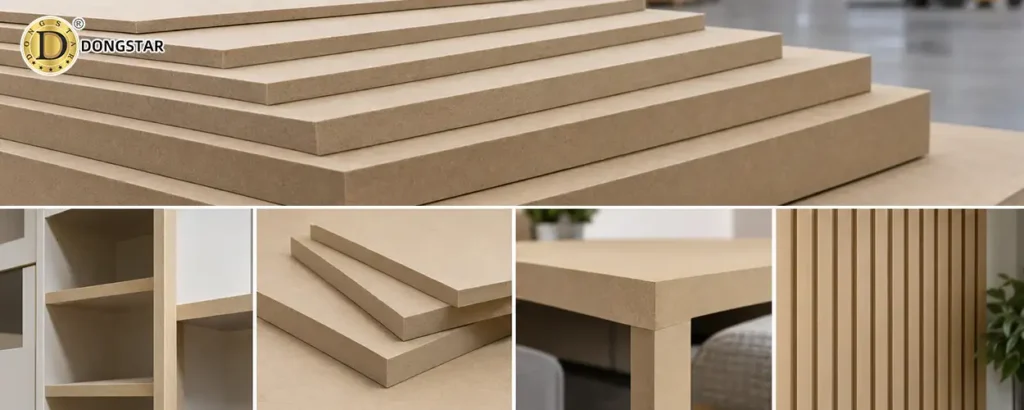
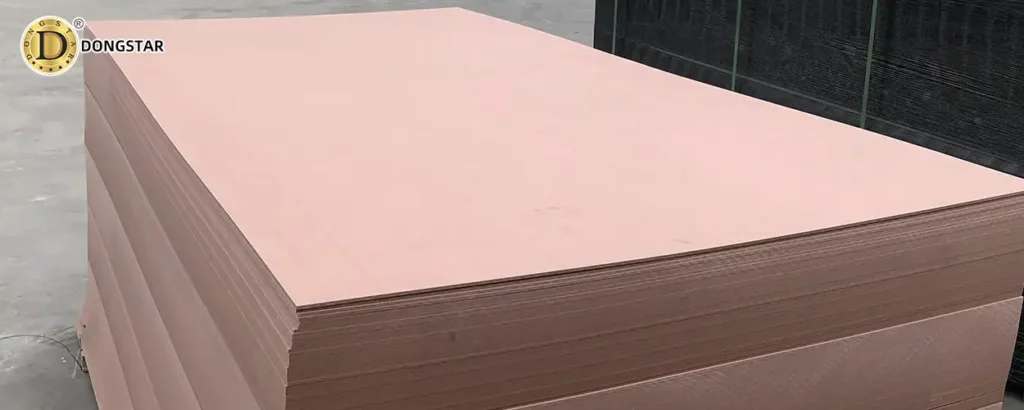
MDF stands for Medium Density Fiberboard. It is an engineered wood panel made from refined wood fibers bonded with resin and pressed under controlled heat and pressure. Unlike solid wood, MDF has a relatively uniform structure and a smooth surface, which makes it suitable for machining, painting, laminating and furniture manufacturing.
For importers, wholesalers, project contractors and furniture manufacturers, however, the definition is only the starting point. The more important questions are usually about MDF thickness, density, size, surface, emission requirements, certifications and supply consistency.
What Is MDF Board?
MDF board is an engineered wood panel manufactured by processing wood material into fine fibers, mixing the fibers with a bonding system and forming them into panels under heat and pressure.
The manufacturing process creates a relatively homogeneous board without the natural grain variations and knots found in solid timber.
This gives MDF several characteristics that are valuable in industrial production:
Smooth and uniform surface
Consistent internal structure
Good CNC machining performance
Easy painting and finishing
Suitable for laminating and veneering
Consistent panel dimensions
Available in a wide range of thicknesses and densities
For furniture factories, this consistency can make MDF easier to process repeatedly than many natural wood materials.
How Is MDF Board Made?
The basic MDF manufacturing process involves several stages.
1. Wood Fiber Preparation
Wood material is processed into fine fibers. The quality and preparation of these fibers influence the final board structure.
2. Fiber Blending
The fibers are combined with resin and other required additives. The bonding system can vary according to the MDF grade and target market.
3. Mat Formation
The prepared fibers are distributed into a uniform mat according to the required board density and thickness.
4. Hot Pressing
The fiber mat is pressed under controlled temperature and pressure to form a solid panel.
5. Sanding and Finishing
After pressing, the boards can be trimmed and sanded to achieve the required thickness and surface quality.
Depending on the product, the MDF can then receive additional treatments such as melamine paper, HPL, PVC or other decorative surfaces.
This manufacturing structure is one reason MDF is widely used for furniture and interior products where a smooth, machinable substrate is required.
What Is MDF Board Used For?
MDF is primarily used in furniture manufacturing, interior decoration and other applications where a smooth, consistent and easily machinable panel is required.
Common applications include:
Furniture Manufacturing
MDF is widely used for:
Cabinets
Wardrobes
Desks
Tables
Shelving
TV cabinets
Storage furniture
Decorative furniture components
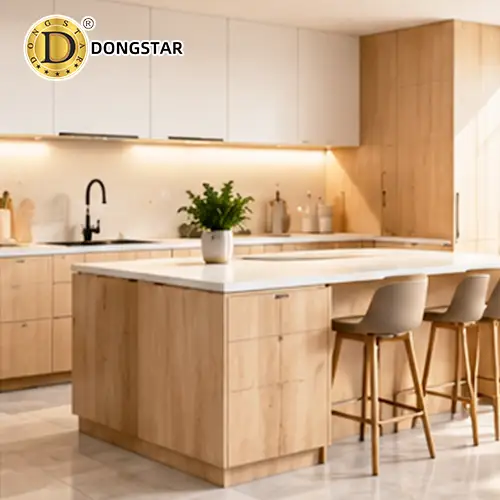
Kitchen Cabinets
MDF can be used for cabinet doors, panels and decorative components. Its smooth surface is particularly suitable for painted or laminated finishes.
Where higher moisture resistance is required, buyers should specify an appropriate moisture-resistant MDF grade rather than assuming that standard MDF is suitable for wet environments.
Office and Commercial Furniture
Commercial furniture manufacturers use MDF for office desks, storage cabinets, reception counters, display systems and other interior furniture.
Interior Decoration
MDF can also be processed into:
Decorative wall panels
Mouldings
Feature walls
Interior partitions
Decorative strips
Ceiling elements
Acoustic panel substrates
Doors and Decorative Components
MDF can be used for interior door components, door skins and routed decorative designs. Its uniform structure works well with CNC cutting and profiling.
The appropriate MDF grade depends on the application, environment and performance requirements.
What Are the Main Types of MDF Board?
There is no single MDF specification suitable for every project. Manufacturers and buyers can select different grades according to the intended application.
Raw MDF
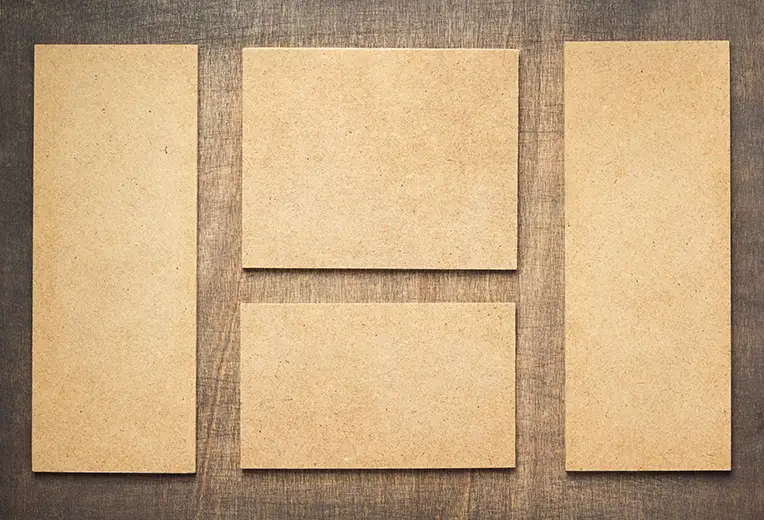
Raw MDF is an unfinished panel that can be painted, veneered, laminated or processed by the buyer.
It is commonly used as a substrate for further furniture manufacturing.
Moisture-Resistant MDF
Moisture-resistant MDF is designed for applications where the board may encounter higher humidity than standard interior conditions.
It should not automatically be treated as waterproof. Buyers should check the manufacturer’s technical data and select the grade according to the actual environment.
Fire-Retardant MDF
Fire-retardant MDF is produced for applications where specific fire-performance requirements apply.
The required certification or fire classification should be confirmed according to the destination market and project specification.
HDF
HDF, or High Density Fiberboard, is a denser form of fiberboard and is used for applications requiring different density and performance characteristics.
Dongstar’s current MDF/HDF range includes Raw MDF, MHR MDF, FR MDF and HDF, depending on the selected specification.
What MDF Thickness Should You Buy?
MDF thickness should be selected according to the furniture design, machining process, required rigidity and final application.
Commonly purchased specifications include:
| MDF Thickness | Typical Applications |
|---|---|
| 2–3 mm | Back panels, thin components and decorative parts |
| 6 mm | Cabinet backs and interior components |
| 9 mm | Furniture parts and decorative panels |
| 12 mm | Furniture components and shelving |
| 15 mm | Furniture, doors and interior applications |
| 18 mm | Cabinets, shelving and furniture panels |
| 22–25 mm | Heavy furniture and specialized components |
| 30 mm | Thick furniture components and customized projects |
These are purchasing guidelines rather than structural design recommendations.
For example, 18mm MDF board is a commonly requested specification for furniture because it provides a useful balance between panel thickness, rigidity, machining and material consumption.
Dongstar currently lists MDF/HDF from approximately 2mm to 30mm, including 2.7mm, 3mm, 6mm, 9mm, 12mm, 15mm and 18mm.
What Is the Standard MDF Board Size?
One of the most widely used MDF formats is 1220 × 2440mm, commonly described as a 4×8 MDF board.
International buyers may encounter several versions of the same size:
1220 × 2440mm MDF
2440 × 1220mm MDF
4×8 MDF board
4×8 MDF sheet
48 × 96 inch MDF
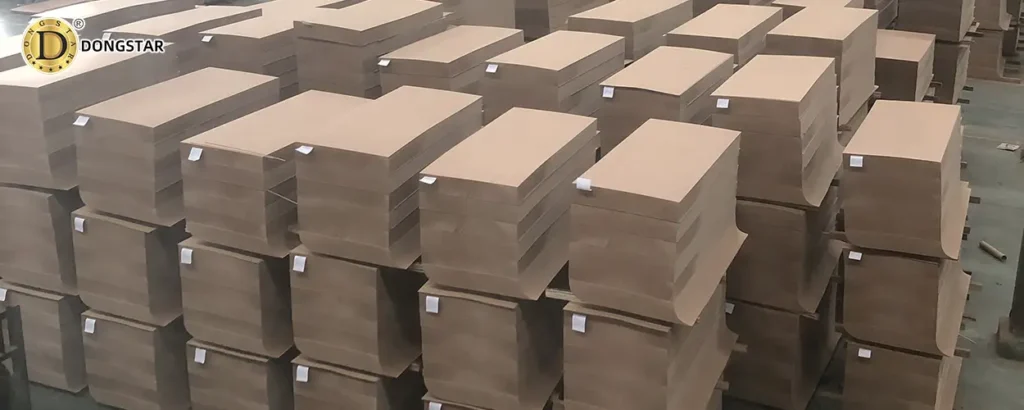
For large-volume orders, buyers should always confirm the actual finished dimensions and tolerance with the manufacturer.
Dongstar lists 1220 × 2440mm as a standard MDF/HDF size and also indicates that other sizes can be discussed according to requirements.
What Is MDF Density and Why Does It Matter?
Density is an important specification when comparing MDF suppliers.
Two boards can have the same size and thickness but different densities. This can affect:
Sheet weight
Machining behaviour
Screw holding performance
Surface quality
Panel rigidity
Container loading
Material cost
Dongstar currently lists MDF/HDF density from approximately 650 to 1200 kg/m³, depending on the product specification.
For a professional RFQ, it is therefore better to specify the required density or application rather than asking only for “18mm MDF.”
What Surface Options Are Available?
MDF can be supplied as a raw panel or with different decorative surfaces.
Depending on the product, common options include:
Plain or sanded MDF
Melamine-faced MDF
HPL-faced MDF
PVC-faced MDF
Decorative finishes
Matte surfaces
Glossy surfaces
Textured or embossed surfaces
Dongstar’s published MDF/HDF specifications include plain boards as well as melamine paper, HPL and PVC surface options.
For furniture manufacturers, the surface should be selected according to the production process. A factory that already has painting or laminating equipment may prefer raw MDF, while a distributor may require ready-to-use decorative panels.
MDF Board vs Particle Board: What Is the Difference?
MDF and particle board are both engineered wood panels, but their structures are different.
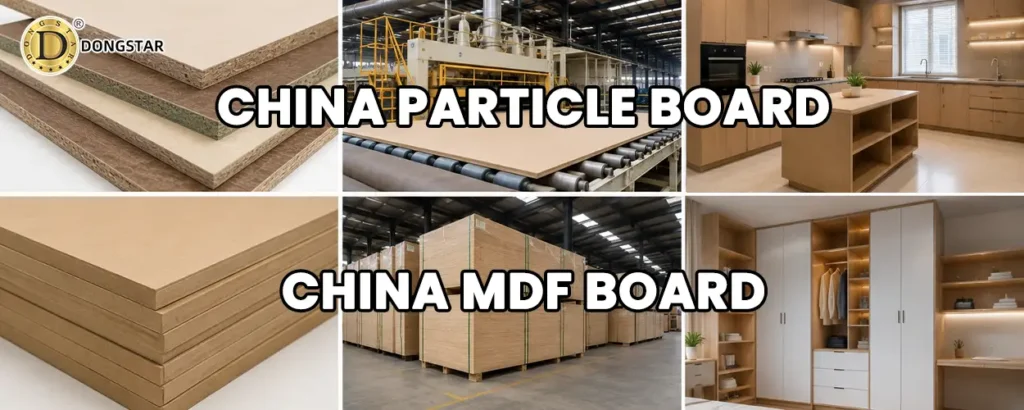
MDF is made from finer wood fibers and has a relatively uniform structure. It is particularly suitable for smooth painted surfaces, CNC machining, routing and decorative furniture.
Particle board, also called chipboard, is manufactured from larger wood particles. It is widely used in cost-sensitive furniture and panel applications.
For a buyer, the choice should be based on the application rather than simply asking which material is “better.”
MDF is often considered when surface quality and detailed machining are important, while particle board can be attractive for applications where material cost and lightweight construction are key factors.
For a more detailed purchasing comparison, see Dongstar’s guide to MDF vs Particle Board.
What Should Global Buyers Check Before Buying MDF Board?
For project orders and container-scale purchasing, price per sheet should not be the only consideration.
A complete MDF purchasing specification should include:
| Specification | What to Confirm |
|---|---|
| Size | 1220 × 2440mm or custom size |
| Thickness | Required thickness |
| Density | Required density range |
| Grade | Raw / MR / FR / HDF |
| Surface | Plain / Melamine / HPL / PVC |
| Glue / Emission | Required market standard |
| Thickness tolerance | Manufacturer’s declared tolerance |
| Certification | Destination-market requirements |
| Packaging | Export packaging |
| Quantity | Sheets / pallets / containers |
| Destination | Country and port |
Dongstar’s published MDF/HDF specifications include E0/E1/E2 glue options and certifications including ISO, CE, CARB and FSC. The exact certification and technical specification should be confirmed for the product being quoted.
Why Choose Dongstar for China MDF Board Supply?
For international buyers, sourcing from a manufacturer is about more than finding a low initial quotation.
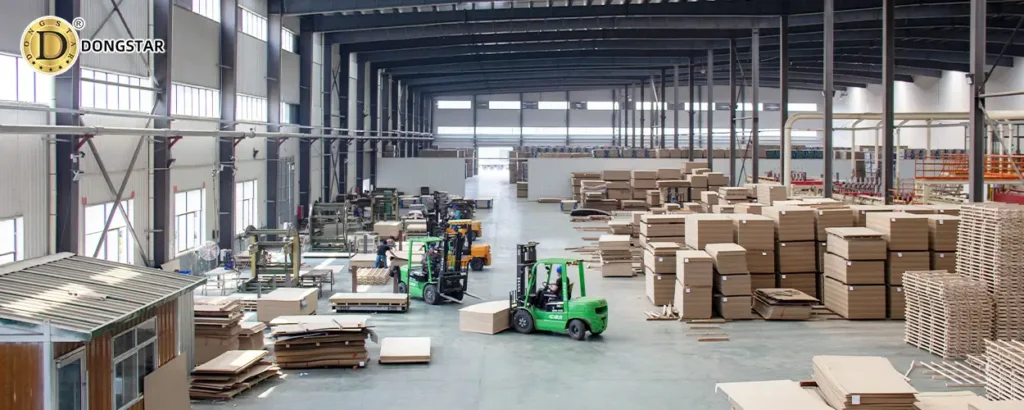
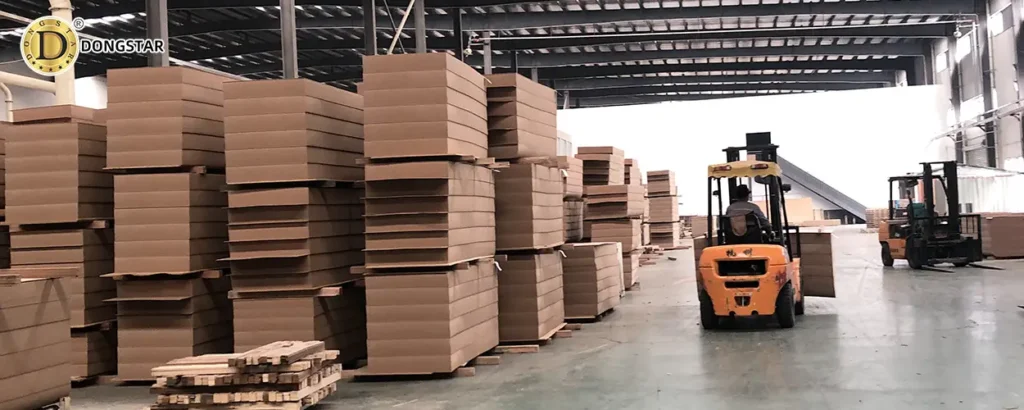
Dongstar is a China-based wood-panel manufacturer and supplier offering MDF/HDF together with plywood, OSB, particle board, melamine board and other engineered wood products.
Its current MDF/HDF range covers standard 1220 × 2440mm sheets, approximately 2–30mm thicknesses, different board types and multiple surface options.
This gives furniture manufacturers, importers, wholesalers and project contractors the opportunity to discuss different specifications within a broader wood-panel supply chain.
For a bulk order, buyers can provide the required size, thickness, density, surface, emission standard, quantity, packaging and destination port. A complete specification allows the manufacturer to prepare a more meaningful quotation and reduces misunderstandings before production.
What Should You Put in an MDF Wholesale RFQ?
Instead of sending:
“Please quote MDF board.”
A professional RFQ should look more like this:
Product: MDF Board
Size: 1220 × 2440mm
Thickness: 18mm
Density: Required range
Surface: Raw / Sanded / Melamine
Emission: Required standard
Quantity: Project / Container quantity
Packaging: Export packaging
Destination: Port and country
Certification: Required documents
This approach makes it easier to compare different MDF board suppliers, MDF sheet manufacturers and wholesale quotations on the same technical basis.
FAQs About MDF Board
MDF stands for Medium Density Fiberboard. It is an engineered wood panel made from wood fibers bonded with resin and formed under controlled heat and pressure.
MDF is widely used for furniture, cabinets, wardrobes, shelving, office furniture, decorative panels, doors and interior applications.
18mm MDF is commonly used for furniture, cabinets, shelves and other relatively thick panel components. The appropriate thickness depends on the product design, span, fixing method and expected load.
1220 × 2440mm is a widely used MDF sheet format, commonly known as a 4×8 MDF board.
Standard MDF should not be treated as waterproof. For applications involving higher humidity, buyers should specify a suitable moisture-resistant grade and follow the manufacturer's technical recommendations.
Depending on production capability and order quantity, manufacturers may offer customized dimensions, thicknesses, densities, surfaces and other specifications. Buyers should confirm MOQ, tolerance and lead time before ordering.
Final Takeaway: What Is MDF Board?
MDF board is an engineered wood panel designed for consistent manufacturing, machining and finishing. Its smooth surface and uniform structure make it especially useful for furniture, cabinets, interior decoration and other commercial applications.
For international buyers, however, “MDF board” is not a complete purchasing specification.
Before ordering, confirm the size, thickness, density, MDF grade, surface treatment, emission requirements, certification, packaging and quantity.
For many furniture applications, 18mm MDF and 1220 × 2440mm MDF are important commercial specifications, while other thicknesses and sizes can be selected according to the project.
If you are looking for a China MDF board supplier, MDF sheet manufacturer or bulk MDF supplier, Dongstar can discuss the required specification and provide a project-specific quotation.