Table of Contents
For importers, furniture manufacturers, wholesalers, distributors, and project contractors, choosing the right engineered wood panel can directly impact product quality, customer satisfaction, and profit margins.
Among all wood-based panels available today, two products dominate the global furniture and interior decoration industries:
- MDF Board
- Particle Board
However, many buyers still struggle with an important question:
Which one should you import—MDF or Particle Board?
As global furniture production continues shifting toward cost efficiency and sustainability, understanding the differences between MDF and Particle Board has become increasingly important.
This guide provides a practical comparison based on manufacturing, durability, cost, applications, and sourcing considerations to help buyers make the right decision.
What Is MDF?
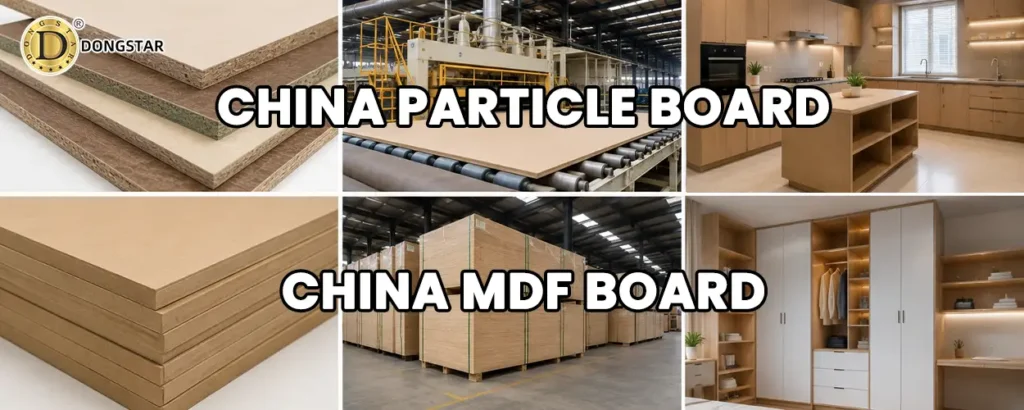
MDF (Medium Density Fiberboard) is an engineered wood panel manufactured from refined wood fibers combined with resin and wax under high temperature and pressure.
Unlike plywood, MDF does not contain wood veneers.
Instead, it has a homogeneous internal structure that provides:
- smooth surfaces
- excellent machinability
- uniform density
- superior painting performance
Because of these characteristics, MDF has become one of the most popular materials in furniture manufacturing worldwide.
What Is Particle Board?
Particle Board, also known as chipboard, is produced using wood particles, chips, sawdust, and resin compressed into sheets. Compared with MDF, Particle Board contains larger wood particles and has a less uniform internal structure. Its main advantages include:- lower manufacturing cost
- lightweight construction
- wide availability
- cost-effective furniture production
MDF vs Particle Board: Key Differences
Density and Structure
MDF consists of fine wood fibers.
Particle Board contains larger wood chips and particles.
As a result:
MDF Advantages
- smoother surface
- better edge finishing
- improved machining
- stronger screw holding
Particle Board Advantages
- lighter weight
- lower production cost
- easier transportation
Surface Quality
Surface quality is one of the biggest differences between the two products.
MDF Surface
MDF provides:
- exceptionally smooth finish
- easy painting
- precise CNC cutting
- superior decorative applications
This makes MDF the preferred choice for premium furniture manufacturers.
Particle Board Surface
Particle Board often requires:
- melamine lamination
- veneer application
- decorative overlays
to achieve similar appearance standards.
Strength and Durability
When evaluating furniture performance, strength becomes critical.
MDF
Offers:
- better internal density
- stronger screw retention
- higher machining stability
Ideal for:
- kitchen cabinets
- wardrobe systems
- decorative wall panels
- office furniture
Particle Board
Offers:
- adequate strength for budget furniture
- acceptable structural performance
However, repeated assembly and disassembly can weaken fastener holding capacity.
Moisture Resistance
Standard MDF and Particle Board are both vulnerable to water exposure.
However, moisture-resistant variants are available.
Moisture Resistant MDF
Widely used in:
- kitchens
- bathrooms
- commercial interiors
Moisture Resistant Particle Board
Provides moderate protection but generally performs below MDF under humid conditions.
Cost Comparison
Cost remains one of the most important factors for importers.
Particle Board
Typically costs:
10%–30% less than MDF
depending on specifications and market conditions.
MDF
Generally commands a higher price due to:
- refined manufacturing
- higher density
- improved finishing performance
MDF vs Particle Board for Furniture Manufacturing
Furniture remains the largest application sector for both products.
Choose MDF If You Need:
- premium furniture
- painted furniture
- routed decorative designs
- CNC processing
- luxury cabinetry
Choose Particle Board If You Need:
- flat-pack furniture
- budget furniture
- high-volume production
- cost-sensitive projects
This is why many ready-to-assemble furniture brands continue using Particle Board for mass-market collections.
MDF vs Particle Board for Interior Decoration
Interior designers increasingly prefer MDF for decorative applications because of its smooth surface and versatility.
Popular applications include:
- wall panels
- decorative moldings
- shelving systems
- display fixtures
- retail interiors
Particle Board is commonly used where aesthetics are less critical.
Why Global Buyers Are Increasingly Sourcing MDF from China
China remains one of the world’s largest MDF manufacturing hubs.
Professional China MDF Board suppliers offer:
- large production capacity
- competitive pricing
- OEM support
- stable quality control
- export experience
For importers, sourcing directly from a China MDF Board factory often provides significant cost advantages.
Why China Particle Board Suppliers Remain Competitive
China Particle Board manufacturers continue investing in:
- advanced production lines
- low-emission panels
- sustainable materials
- melamine finishing technologies
This makes China one of the most competitive sourcing destinations globally.
MDF vs Particle Board for Importers: Which Delivers Better ROI?
The answer depends on your target market.
Premium Market
Recommended Product:
MDF
Benefits:
- higher product value
- superior appearance
- better durability
- stronger customer satisfaction
Budget Market
Recommended Product:
Particle Board
Benefits:
- lower cost
- competitive pricing
- mass production suitability
- improved margins in price-sensitive regions
How to Choose a Reliable China MDF Board Supplier
Before placing large orders, buyers should verify:
Manufacturing Capacity
Look for:
- factory videos
- production facilities
- warehouse capacity
Certifications
Request:
- FSC
- CARB P2
- EPA
- CE
- ISO
Quality Control Systems
Evaluate:
- thickness tolerance
- density consistency
- moisture content
- surface finishing
How to Choose a Reliable China Particle Board Supplier
Important considerations include:
Raw Material Quality
High-quality wood particles improve panel performance.
Formaldehyde Standards
Verify compliance with:
- E0
- E1
- CARB
- EPA regulations
Export Experience
Experienced exporters reduce:
- shipping delays
- packaging damage
- customs issues
Market Trends Driving MDF and Particle Board Demand in 2026
Several global trends continue supporting demand.
Furniture Manufacturing Growth
Demand remains strong across:
- North America
- Europe
- Middle East
- Southeast Asia
Sustainable Building Materials
Buyers increasingly prioritize certified wood panels.
Modular Furniture Expansion
Ready-to-assemble furniture continues driving Particle Board consumption globally.
Premium Interior Design Growth
Luxury residential and commercial projects continue increasing MDF demand.
Why Importers Work with Dongstar
As a professional wood panel supplier, Dongstar supports global buyers with:
- MDF Board
- Melamine MDF
- Particle Board
- Plywood
- Film Faced Plywood
The company focuses on:
- stable quality
- OEM production
- export-oriented service
- strict quality control
- reliable delivery schedules
FAQs
Yes. MDF generally offers higher density and better screw holding performance.
For premium furniture, MDF is usually preferred.
For budget furniture, Particle Board is often more economical.
Standard MDF is not waterproof, but moisture-resistant MDF is available.
Particle Board uses larger wood particles and a simpler manufacturing process, reducing production costs.
MDF is generally preferred because of its smooth surface and machining performance.
Yes. China offers competitive pricing, large production capacity, and extensive export experience.
Final Thoughts
When comparing MDF vs Particle Board in 2026, there is no universal winner.
The right choice depends on:
- target market
- product positioning
- budget
- application requirements
For premium furniture and decorative projects, MDF typically delivers superior quality and customer satisfaction.
For cost-sensitive applications and high-volume production, Particle Board remains a highly competitive option.
The most successful importers evaluate both materials strategically and partner with experienced China MDF Board and China Particle Board suppliers capable of delivering consistent quality and reliable export support.