Table of Contents
For a cabinet order, the deciding factor may be hinge retention. For interior doors, it may be surface consistency. For a flooring distributor, it is the performance of the complete floor system. Comparing HDF and plywood by sheet price alone misses these differences.
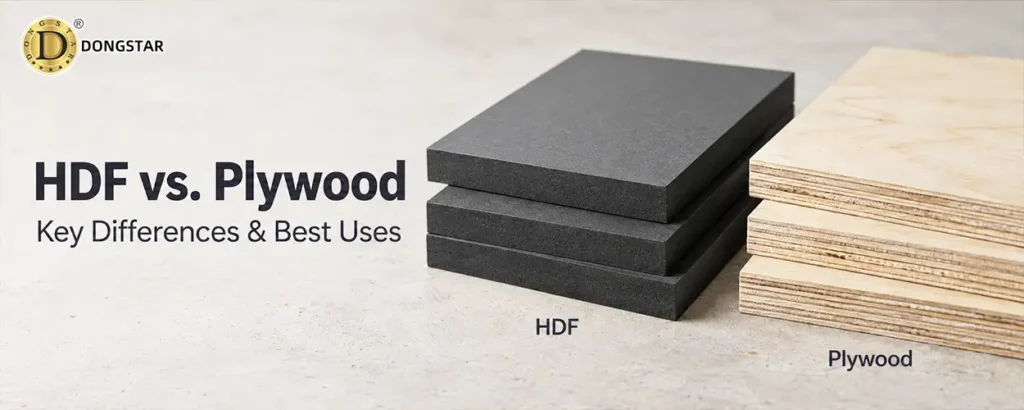
HDF is a dense wood-fiber panel suited to smooth surfaces, interior door skins and specified flooring cores. Veneer-core plywood uses cross-laminated wood veneers and is generally the stronger choice for cabinet boxes, loaded shelving and applications requiring reliable fastener retention. Moisture performance depends on the actual grade, adhesive and finished assembly—not the material name.
For project contractors, wholesalers and importers, the useful question is: which specification delivers the required performance at the lowest cost per usable component?
HDF vs. Plywood at a Glance
This comparison refers to dry-process HDF and veneer-core plywood. Decorative plywood can also have an MDF or other composite core, so confirm the construction on the quotation.
| Buying factor | HDF | Veneer-core plywood |
|---|---|---|
| Construction | Fine wood fibers bonded and compressed into a dense panel | Wood veneers bonded in alternating grain directions |
| Surface | Smooth and uniform for coating or lamination | Depends on face veneer and sanding quality |
| Strength | Grade-dependent; density alone does not establish load capacity | Often better suited to loaded components; grade, thickness and span matter |
| Fasteners | Performance varies with thickness, density and edge distance | Usually a better starting point for hinges and structural joints |
| Moisture | Standard grades can swell when wet; moisture-resistant grades need verification | Performance depends on bond classification, core and protection |
| Weight | Often heavier at equal thickness | Varies significantly by core species |
| Typical uses | Door skins, flooring cores, supported back panels | Cabinet boxes, shelving, furniture frames; structural work with rated grades |
| Cost | Can offer economical surface finishing | May reduce reinforcement, fixing and handling costs |
Neither material is automatically waterproof, structural or compliant with a destination market’s requirements.
What Is HDF?
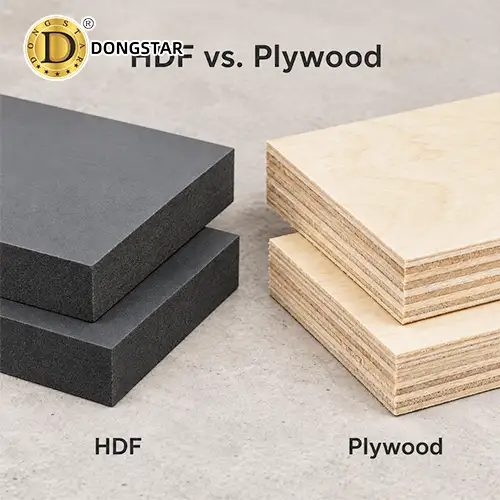
High-density fiberboard is manufactured from refined wood fibers, resin and additives pressed under heat and pressure. Its uniform structure provides a consistent surface without visible veneer joints or natural grain patterns.
HDF is commonly used in laminate flooring cores, interior door skins and thin furniture components. Products sold as HDF vary in density, thickness and moisture performance. Request the technical data sheet rather than treating “high density” as a complete specification.
HDF and MDF belong to the same broad family of fiber-based panels, but they are not interchangeable grades. If a supplier lists both on one product page, confirm which thicknesses and properties apply to the HDF being quoted.
What Is Plywood?
Veneer-core plywood consists of thin wood sheets bonded in alternating grain directions. This construction helps distribute loads and limits the movement associated with a single piece of solid wood.
For buyers, the important variables are core species, veneer quality, layup, face grade, bond performance and thickness tolerance. Two panels described as “18 mm plywood” can perform very differently during machining and assembly.
Use the plywood core guide to compare constructions before selecting a face veneer or requesting prices.
HDF vs. Plywood for Cabinets and Commercial Furniture
For cabinet boxes, wall-mounted units and loaded shelves, cabinet grade plywood is often the more practical starting point. It can provide a useful combination of stiffness, manageable weight and fastener retention, provided the core is sound and the assembly is properly designed.
HDF can be suitable for supported cabinet backs, drawer bottoms and selected decorative components. Thin panels should not be substituted for loaded parts without checking deflection, fixing methods and the finished design.
For painted cabinet doors, compare the actual machining and coating performance of the proposed HDF or MDF grade. A smoother surface can reduce preparation work, but edge finishing and hardware attachment still need testing.
A mixed-material specification can make more sense than choosing one board for the entire cabinet: plywood for the box and loaded components, with an appropriate fiberboard grade for selected surface-focused parts.
For hospitality and retail fit-outs, inspect finished samples under the intended lighting. Surface defects that look minor on raw panels can become obvious after painting or high-gloss lamination.
HDF vs. Plywood for Flooring and Doors
Flooring: distinguish the core from the subfloor
HDF is widely used as the core of laminate flooring. The complete product combines the core with decorative and protective layers, a balancing layer and a joint system. Raw HDF board is not a finished commercial floor.
For flooring purchases, request the finished product’s use classification, wear performance, dimensional stability and water-resistance test results. A dense core alone does not establish suitability for heavy commercial traffic.
Plywood serves a different role in many floor assemblies: structural subflooring or specified underlayment. Select the grade and thickness for the support spacing, load and flooring manufacturer’s requirements. General decorative plywood should not be assumed suitable for structural subfloors.
Doors: surface quality and assembly quality both matter
HDF door skins suit interior-door production where consistent surfaces and repeatable finishes matter. Check skin thickness, molding quality, bonding and dimensional tolerances against an approved sample.
Plywood may be preferred where a natural veneer appearance or a particular door construction is required. Neither an HDF skin nor a plywood face establishes a fire or acoustic rating; those claims require evidence for the complete door assembly.
Moisture Resistance: Check the Grade, Not the Label
Standard HDF can suffer permanent thickness swelling when water reaches unprotected edges or joints. Moisture resistant HDF can perform better, but suitability depends on documented testing and the intended exposure.
Plywood also varies. Interior-bonded panels are not a substitute for exterior-bonded panels. For structural plywood, APA distinguishes Exposure 1 bonding for temporary weather exposure from Exterior bonding for longer-term exposure conditions. An exterior bond does not make wood immune to decay.
For sink cabinets, humid interiors or projects involving wet installation conditions, specify:
- Expected exposure and the applicable panel grade.
- Bond durability or thickness-swelling requirements, with the test method.
- Edge sealing, joint protection and storage conditions.
- Acceptance criteria for swelling, delamination and flatness.
Ask for the adhesive and bond-test specification. Labels such as “MR” or “WBP” on a quotation should be supported by measurable requirements. Dongstar’s plywood glue options provide a starting point for that discussion.
HDF vs. Plywood Cost: Compare Landed Cost and Yield
HDF may offer a lower purchase price for some applications, especially where a smooth surface reduces finishing work. That advantage can narrow if heavier panels increase freight costs or the component requires additional support.
Plywood may cost more per sheet but reduce weight, reinforcement or assembly work. Core defects and face quality can still affect cutting yield and reject rates.
A useful comparison is:
Cost per usable component = (landed panel cost + processing cost + expected rework and waste cost) ÷ accepted components produced.
For illustration, assume two sheets each produce four components. A $24 sheet costs $6 per component before processing. A $20 sheet also costs $6 per component if it requires $4 of additional processing per sheet. These are hypothetical figures, not current market prices.
Compare quotes using the same dimensions, tolerance, finish, packing and Incoterm. For bulk plywood orders or HDF shipments, confirm both container volume and payload limits rather than assuming equal sheet counts mean equal freight efficiency.
What to Confirm Before a Bulk Order
An HDF board supplier or plywood supplier in China should quote against a written specification covering:
- Application: cabinet box, door skin, flooring core or another defined component.
- Panel construction: fiberboard grade or plywood core, layup and face quality.
- Dimensions: thickness, tolerance, sheet size, flatness and cutting requirements.
- Performance: relevant bending, fastener, bonding or swelling tests.
- Market documentation: product-specific emissions, sourcing and other required records.
- Shipment: quantity, pallet protection, loading plan, delivery terms and inspection criteria.
For covered composite wood products entering the United States, verify applicable TSCA Title VI certification, labeling and records. Do not assume a generic “E0,” “E1” or “CARB” statement establishes every required obligation. Confirm the product category and current destination requirements before ordering.
Approve a production-representative sample and retain it as the reference for inspection. A sample is most useful when it has been cut, finished and assembled using your intended process.
FAQ
Higher density does not automatically mean greater strength. Veneer-core plywood is generally better suited to loaded cabinet parts and fastened assemblies, while HDF offers a uniform surface. Compare relevant test values at the specified thickness and span.
Standard HDF is not waterproof. Moisture-resistant grades and finished flooring systems can offer improved performance, but their test conditions and limits must match the application. Protect cut edges and joints.
Plywood is often preferred for cabinet boxes and loaded shelving. Suitable HDF or MDF grades may be used for selected doors and supported components. Around sinks, panel specification and edge protection are particularly important.
It can be, but prices depend on grade, thickness, finish, order size and delivery terms. Compare landed cost, processing and usable yield rather than the supplier's sheet price alone.
Do not substitute ordinary HDF for specified structural plywood. Structural applications require panels qualified for the design, loads and applicable building requirements.
Include the application, destination, dimensions, panel grade, finish, quantity and required documentation. State the Incoterm and inspection criteria so suppliers can prepare comparable quotations.
Compare Specifications Before Requesting a Quote
Dongstar lists MDF and HDF board options, hardwood plywood and HDF door skins for furniture and interior applications. Confirm grade-specific availability and documentation for your order.
Planning a project or wholesale plywood purchase? Send Dongstar your panel specification with the application, destination, size, thickness, finish and quantity. Request a comparison of suitable grades, samples, packing and delivery terms before committing to bulk supply.