Table of Contents

Is MDF Waterproof? What Bulk Buyers Should Specify Instead

Standard MDF is not waterproof. Moisture-resistant MDF can be suitable for humid interiors and occasional splashes when the grade, finish and edge protection match the application. Neither a moisture-resistant label nor a laminated face establishes suitability for standing water, repeated washdowns or outdoor exposure.

A hotel vanity can arrive with an intact finish and still swell around a plumbing cutout after installation. For project contractors, wholesalers and importers, the purchasing question is where water can reach the board—and what evidence shows that the finished component can handle that exposure.

What Happens When MDF Gets Wet?

Water can enter MDF through exposed edges, routed profiles, drilled holes and damaged finishes. The fibers absorb moisture and the panel can swell. Severe swelling can leave permanent raised edges and reduce board strength, even after the panel dries.

A finished face can hide the first signs of trouble. When approving a cabinet sample, look closely at the bottom edge, hinge holes and service cutouts. Those details are easy to overlook on a finished showroom panel and difficult to repair once a batch is installed.
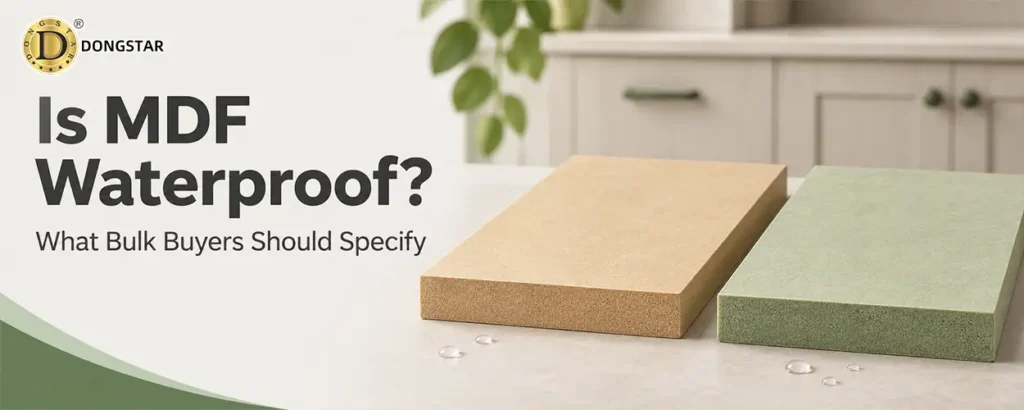
Standard MDF and green moisture-resistant MDF samples with visible cut edges

Standard MDF, Moisture-Resistant MDF and Exterior MDF

Board typeWhere to consider itWhat to verify before ordering
Standard MDFFurniture, cabinetry and decorative panels in dry interiorsExpected exposure and any project requirements for the finished component
Moisture-resistant MDF (MR MDF)Humid interior cabinetry and fit-outs where the specified grade and finish suit the expected exposureDeclared grade, swelling results and treatment of cut edges and holes
Exterior-grade MDFExterior applications explicitly covered by the manufacturer’s instructionsPermitted exposure, installation details and the specified coating system

The European Panel Federation’s guide to specialty MDF grades distinguishes MDF.H for general use in humid conditions from MDF.HLS for load-bearing use in humid conditions under EN 622-5. These classifications describe intended service conditions; they do not establish suitability for permanent immersion.

Suppliers may use terms such as MR MDF, HMR MDF or green MDF. Put the declared grade and acceptance criteria on the purchase order. Color is a visual identifier, and a trade label alone does not tell you how much the board will swell.

Where Can Buyers Use Moisture-Resistant MDF?

Start with the exposure at each component rather than assigning one grade to the entire room.

ApplicationPractical specification decision
Kitchen cabinet doorsConsider MR MDF where occasional splashes or humidity are expected. Approve the routed profile and finished edges as part of the sample.
Hotel bathroom vanitiesAssess the fronts, plinth and plumbing cutouts separately. Use a substrate verified for the exposure wherever repeated wetting or pooling is likely.
Laundry and utility cabinetsCheck whether leaks, wet floors or cleaning practices could expose the base. Detail the cabinet so vulnerable edges are clear of wet surfaces.
Commercial washdown areasSpecify a panel system documented for repeated wetting and the cleaning method. An MR MDF label alone is insufficient.
Outdoor fixturesUse only a product explicitly approved for the exposure, with the manufacturer’s specified finish and installation details.

For kitchens and bathrooms, the European Panel Federation emphasizes protecting exposed edges where intermittent wetting is expected. For exterior use, it also calls for a suitable finishing system on all faces and edges.

If you are comparing substrates for different cabinet components, see our guide to MDF vs plywood for cabinets.

Does Melamine or Laminate Make MDF Waterproof?

No. A decorative facing can protect the covered surface, but the finished panel still has seams, cut edges and holes. A melamine-faced MDF panel with an exposed sink cutout can still absorb water through that opening. The same consideration applies to HPL, PVC and painted finishes: assess how the entire part is protected after machining and installation. mdf-info.eu

For bulk production, ask the supplier to identify which edges are factory finished and which are cut on site. Assign responsibility for sealing field cuts in the installation specification. Otherwise, a sample can pass approval while the installed product remains vulnerable.

How to Verify Moisture Resistance Before a Bulk Order

1. Request a test report for the board you are buying

Ask for the product code, tested thickness, method and result. EN 317 thickness swelling measures how much a specimen increases in thickness after a 24-hour water immersion. It helps compare boards tested under the same conditions. It does not demonstrate that the finished cabinet can remain submerged. Where the project requires cyclic moisture testing, request the applicable report and agreed limits.

For example, if an illustrative 18.0 mm specimen measures 19.8 mm after testing, its thickness swelling is 10%: (19.8 − 18.0) ÷ 18.0 × 100. This is a calculation example, not a pass limit or a Dongstar product result.

2. Approve a finished component

Request a production-representative sample with the actual substrate, face finish, edge treatment and machining. A vanity sample should include a plumbing cutout; a routed door sample should include the intended coating on the profile. Use any agreed finished-part exposure test alongside the substrate report, since they answer different questions.

3. Put acceptance criteria in the RFQ and purchase order

RFQ itemWhat to specify
Use and exposureComponent, installation environment and expected contact with water
Panel specificationGrade, nominal thickness, sheet size and tolerances
Moisture performanceAgreed test method, applicable limit and report for the quoted board
Finish and fabricationFace and back finishes, edge treatment and responsibility for sealing site cuts
Shipment inspectionApproved sample, product and lot identification, and checks for damaged wrapping, wet packs or visibly swollen edges

For importers comparing moisture-resistant MDF suppliers, the most useful quote identifies the board and its acceptance criteria in writing. A lower-priced quotation is difficult to evaluate if it does not cover the same grade, finish and documentation.
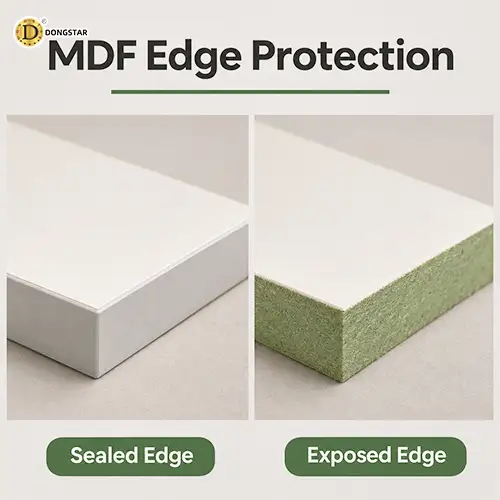
Sealed edge beside an exposed green MDF cut edge on two laminated panels

FAQ

No. It is designed to resist moisture better than standard MDF under specified conditions. Suitability for repeated direct wetting, standing water or exterior exposure must be verified separately.

Color alone cannot verify moisture resistance. Ask the supplier for the grade, technical data sheet and relevant test results for the quoted board.

It depends on the component and how it will be exposed. MR MDF may be suitable for a properly finished vanity front. A base panel exposed to recurring leaks or pooling needs a substrate documented for those conditions.

A compatible coating can reduce surface exposure, but it does not change the underlying board grade. Cutouts, joints and damaged finishes remain potential entry points.

Moisture content describes how much water the board contains when measured. Thickness swelling describes how much thicker a specimen becomes after a defined exposure. A delivery moisture reading does not establish how the panel will respond to wetting.

Request MDF Specifications for Your Project

Dongstar’s MDF and HDF board range lists raw MDF, a green moisture-resistant MDF option, and decorative finishes including melamine, HPL and PVC. Confirm the exact grade, finish combination and supporting documentation for your order.

Request panel specifications and samples. Include the component drawing, expected exposure, thickness, finish, order quantity and destination market so the options can be compared against your project requirements.
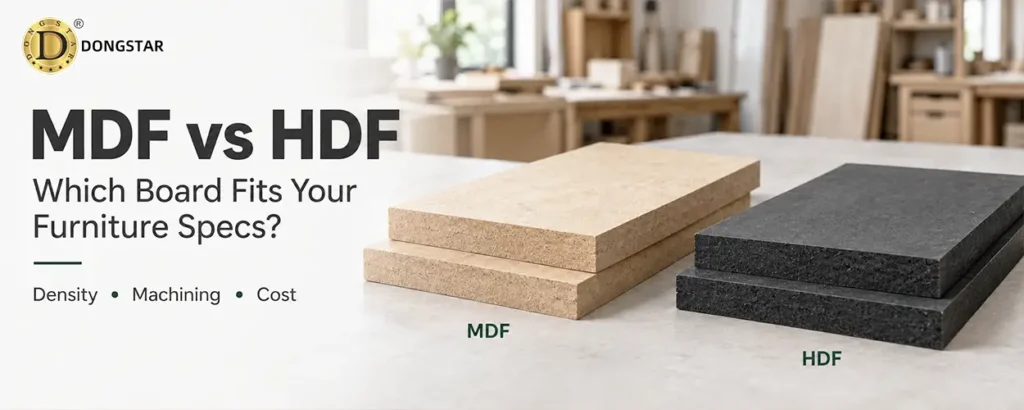
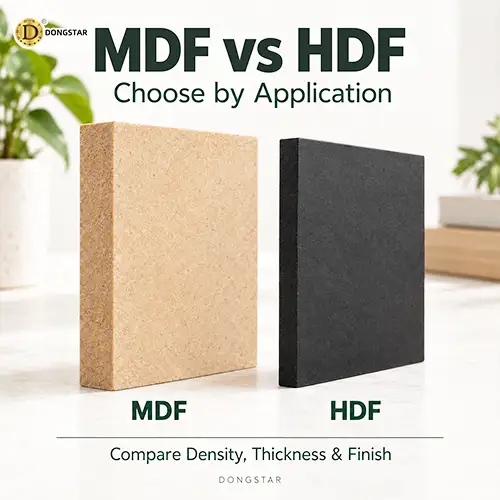
Table of Contents

MDF vs HDF: Which Board Should Furniture Buyers Specify?

MDF is generally a practical starting point for routed doors, furniture panels and decorative interiors. HDF is often selected for thin components such as cabinet backs, drawer bottoms and specialist flooring substrates. The better purchase depends on the component—not density alone.

For importers, wholesalers and project buyers, choosing between MDF and HDF affects machining, finishing, shipment weight and production cost. Ordering the denser board without checking the application can add expense without solving a performance problem.

This guide explains the differences and the specifications worth confirming before a bulk order.

Natural MDF and black HDF board samples for furniture material selection

What Is the Difference Between MDF and HDF?

MDF means medium-density fiberboard. HDF means high-density fiberboard. Both are manufactured from refined wood fibers bonded with resin under heat and pressure.

HDF belongs to the same broad family of dry-process fiberboards. The European Panel Federation describes it as high-density MDF, rather than an entirely different material.

Density is the main distinction, but commercial product names do not tell the whole story. Resin formulation, density distribution, thickness and surface preparation also influence performance.

Buying ConsiderationMDFHDF
Typical purchasing focusMachining, finishing and general furniture componentsThin panels requiring specified density and performance
Density referenceCommonly around 650–800 kg/m³Commonly above 800 kg/m³
Thickness availabilityBroad range, including thin and thick panelsFrequently supplied in thin formats; availability varies
Common applicationsCabinet fronts, furniture panels, mouldings and interior fitmentsFurniture backs, drawer bottoms, door components and flooring substrates
Finishing optionsPaint, veneer, melamine, HPL and foil, depending on gradePaint, lacquer, veneer and laminates, depending on grade
Moisture resistanceMust be specified separatelyMust be specified separately
Main purchasing checkMachining quality and suitability for the componentRequired properties at the actual supplied thickness

The density figures are industry reference points, not universal acceptance limits. Equipment manufacturer Dieffenbacher describes MDF production at 650–800 kg/m³ and HDF above 800 kg/m³. Always use the supplier’s product-specific technical data for purchasing.

1. Is HDF Stronger Than MDF?

Higher density can improve hardness and certain mechanical properties. However, “HDF is stronger” is not a complete specification.

A buyer may need resistance to bending, screw withdrawal, surface indentation or internal separation. These are different properties, and one density figure cannot replace their test results.

Thickness also matters. A thin HDF panel should not replace a thicker MDF shelf simply because its density is higher.

For a proposed substitution, compare:

  • Bending strength and stiffness.
  • Internal bond strength.
  • Screw withdrawal, where relevant.
  • Thickness swelling under the specified test conditions.
  • Performance of the finished component.

Approve the material in its intended construction, including supports, joints and hardware.

2. MDF vs HDF for Furniture: Which Fits Each Component?

Painted cabinet doors and routed fronts

MDF is widely used for profiled furniture components because its fine fiber structure supports machining and decorative finishing. The European Panel Federation identifies doors, drawer fronts and moulded components among established applications.

For MDF cabinet doors, request a routed and finished sample. Inspect edge fuzzing, coating absorption, profile detail and hinge drilling.

High-density grades may also suit demanding profiles. Their value should be demonstrated through machining trials and finished quality rather than the HDF label alone.

Cabinet backs and drawer bottoms

Thin HDF is worth evaluating where the design requires a compact panel with a smooth surface. Published HDF applications include cupboard backs and other furniture components.

Thin MDF can serve similar functions. Compare the two at the required thickness, using the actual fixing method and load.

For drawer bottoms, check the unsupported span, groove engagement and expected contents. For cabinet backs, assess fixing strength, squareness and the back panel’s contribution to the assembled cabinet.

Shelves and full-size furniture panels

Start with panel thickness, span and loading requirements. Suitable MDF may meet the specification without the weight or cost of a denser grade.

Do not select shelving from density alone. Long-term sag and joint performance require attention even when the board looks rigid during initial assembly.

Laminate flooring substrates

HDF is commonly used as a carrier board for laminate flooring.

However, ordinary furniture-grade HDF is not automatically flooring-grade material. Confirm the required swelling performance, dimensional tolerances and suitability for the intended flooring system.

3. Is HDF More Water-Resistant Than MDF?

Higher density does not make a board waterproof. Moisture performance depends on its formulation, classification, protective finish and installation conditions.

A standard HDF product can be intended specifically for dry interiors. For example, Kronospan describes its standard HDF as a non-load-bearing panel for interior use in dry conditions.

For humid environments, request a grade explicitly designed for the exposure. The European Panel Federation distinguishes moisture-resistant, exterior and high-density grades as separate product developments.

Before ordering moisture-resistant MDF or HDF, confirm:

  • The declared service conditions.
  • Thickness-swelling results and test method.
  • Protection required at cut edges and drilled holes.
  • Whether the finished assembly may encounter standing water.

Color is not proof of performance. Green, black or red pigmentation should be checked against the technical specification.

4. Which Board Produces a Better Finish?

Both MDF and HDF can provide suitable substrates for decorative surfaces. The right choice depends on the finishing process.

For painted components, inspect both the face and machined edges. A smooth face does not guarantee that a routed profile will require little preparation.

For melamine-faced MDF, veneered panels or laminated HDF, check:

Production CheckWhy It Matters
Thickness consistencySupports machining accuracy and repeatable assembly
Surface preparationInfluences coating and adhesive performance
Edge conditionAffects sealing, painting and edge banding
Balanced panel constructionHelps control distortion after surfacing
Finished sample approvalReveals defects that raw-board inspection can miss

Request samples processed with your intended tools, adhesive and finish. An unfinished hand sample cannot demonstrate production yield.

5. MDF vs HDF Cost: Compare the Finished Component

HDF may carry a higher price for comparable dimensions and specifications, but there is no reliable universal premium.

Compare quotations using the same:

  • Thickness and sheet dimensions.
  • Surface finish and grade.
  • Performance and emission requirements.
  • Quantity, packing and delivery terms.

For importers, shipment weight deserves particular attention.

Estimated sheet weight = length × width × thickness × density

Using meters and kg/m³, an illustrative 1220 × 2440 × 3mm sheet weighs approximately:

Assumed DensityCalculated Sheet Weight
750 kg/m³6.70 kg
900 kg/m³8.04 kg

These are calculated examples, not Dongstar product specifications. Coatings, moisture and packaging affect actual shipment weight.

A useful purchasing measure is cost per accepted finished component. Include material, machining, finishing, waste, freight and rework. A more expensive board is justified when its production or performance advantage exceeds the added cost.

6. What Should Bulk Buyers Include in an MDF/HDF RFQ?

Avoid sending only “HDF board, best price.” A clear RFQ produces quotations that are easier to compare.

Specify:

  1. Application: cabinet door, back panel, drawer bottom or another component.
  2. Dimensions: sheet size, thickness and permitted tolerances.
  3. Grade: required density range and relevant performance properties.
  4. Surface: raw, sanded, painted, melamine-faced, veneered or laminated.
  5. Environment: dry interior, humid interior or another defined exposure.
  6. Documentation: destination-market requirements and applicable test reports.
  7. Inspection: agreed sampling, defects and acceptance criteria.
  8. Delivery: quantity, packing, destination and Incoterm.

Keep an approved production-representative sample. For repeat orders, compare incoming shipments against the written specification as well as the sample.

Side-by-side comparison of natural MDF and black HDF surfaces and cut edges

FAQ

No. HDF may suit thin components or applications requiring particular mechanical properties. MDF can be a more economical choice when it already meets machining, finishing and performance requirements.

Potentially, if the required thickness and grade are available. Validate routing, finishing, hardware fixing, weight and flatness before approving the change.

No. Color does not establish density or classification. Request the product’s declared density, grade and test data.

Yes. Suitable grades can accept decorative surfaces. Confirm surface preparation, adhesive compatibility and the finished panel’s balance with the supplier.

Approve a component made from the proposed production material. Review its machining, finish, fixing and application performance alongside the technical documentation.

Source MDF and HDF to Your Furniture Specification

Dongstar’s MDF and HDF board range includes raw and specialty panels with decorative surface options. Its published range covers multiple thicknesses and densities; confirm availability for the exact grade and finish required.

Send your component drawings, thickness, finish, destination and estimated quantity to request specifications and samples. Compare suitable options before committing to a bulk order.

Table of Contents

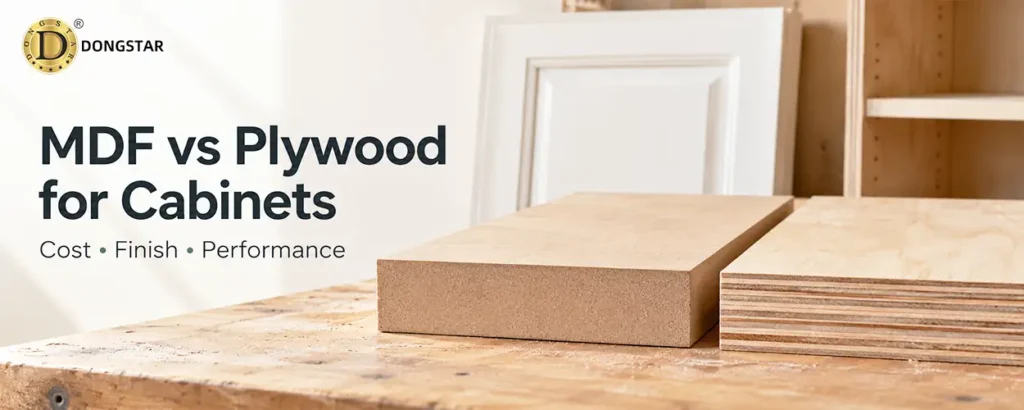
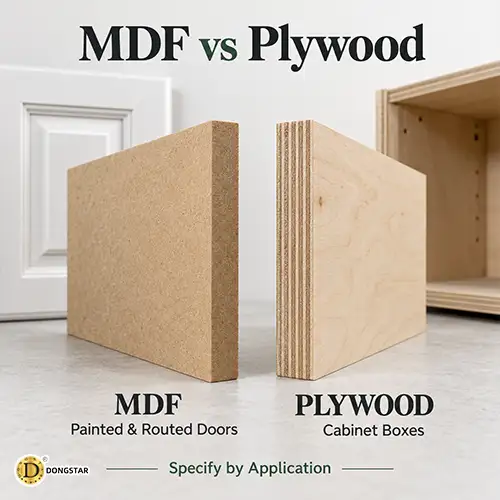
MDF is often the practical choice for painted cabinet doors and routed decorative panels. Quality plywood is usually better suited to cabinet boxes where stiffness, fastening and handling matter. For bulk buyers, the right specification may combine both materials within the same cabinet.

The purchasing decision goes beyond sheet price. Finishing labor, machining yield, hardware performance, freight and replacement costs all affect the final margin.

This guide compares MDF vs plywood for cabinets from the perspective of furniture manufacturers, project contractors, wholesalers and importers.

MDF and plywood samples with a painted cabinet door and plywood cabinet box

MDF vs Plywood: A Cabinet Buyer’s Comparison

MDF consists of refined wood fibers bonded with resin and pressed into panels. Plywood consists of bonded wood veneers, usually arranged with alternating grain directions.

Their different structures influence how they machine, finish and perform.

Purchasing FactorMDFPlywood
Painted finishSmooth substrate without visible wood grain; edges require preparationFace quality matters; grain and repairs may show through paint
Routed cabinet doorsWell suited to detailed profiles when the machining grade is appropriateRouting can expose veneer layers or core gaps
Cabinet boxesSuitable for properly designed interior cabinetsOften preferred where stiffness and fastening are priorities
Screw fixingRequires suitable fasteners, pilot holes and edge distancesQuality cores generally provide dependable fixing; voids can weaken connections
Moisture exposureStandard MDF is vulnerable; specify an appropriate moisture-resistant grade where neededPerformance depends on veneer quality, bond classification and edge protection
WeightOften heavier than lightweight plywood at the same thicknessVaries substantially with wood species and construction
Purchase costOften lower than comparable decorative hardwood plywoodVaries with core, face veneer, grade and adhesive
Main inspection concernEdge quality, thickness consistency and swelling performanceCore gaps, veneer quality, bonding and thickness consistency

These are selection guidelines. Actual performance depends on the supplied grade, component design and service conditions.

1. Which Material Is Better for Cabinet Doors?

MDF for painted and routed doors

For opaque painted finishes, MDF offers a relatively uniform surface without the grain variation found in wood veneers. It also allows profiles to be routed directly into a panel.

The European Panel Federation identifies machining and finishing performance as important reasons for using MDF in furniture and interior components.

For MDF cabinet doors, assess more than the appearance of an unmachined sample. Ask the supplier to provide a sample with your intended profile, hinge drilling and coating system.

Check:

  • Whether routed edges remain clean or become fuzzy.
  • How much sealer and sanding the edges require.
  • Whether hinge screws hold securely in the proposed design.
  • Whether finished doors remain flat after conditioning.

A lower sheet price can lose its advantage if production requires extra sanding or repeated coating.

Plywood for veneered and wood-grain doors

Plywood is a useful option when the design calls for a visible wood veneer finish or a particular panel construction.

Specify face species, veneer grade, repair limits and color consistency. For routed designs, inspect the exposed core: internal gaps that are hidden on a full sheet may become visible after machining.

Practical choice: Start with MDF for smooth painted profiles. Consider plywood where the veneer appearance or component design justifies it.

2. Which Material Is Better for Cabinet Boxes and Shelves?

Cabinet boxes carry hinges, drawer runners, shelves and installed contents. Their performance depends on panel properties and joint design.

Quality cabinet plywood is often selected where stiffness, fastening and handling resistance are important. APA identifies plywood as a suitable material for cabinet and millwork manufacturing, with panel selection tied to the intended application.

MDF can also serve in interior cabinet construction, particularly with decorative surfaces and properly designed connections. However, long shelves and heavily loaded components require attention to deflection and long-term sag.

Before approving either material, confirm:

  • Shelf span and expected load.
  • Panel thickness and support arrangement.
  • Joint and fastener design.
  • Hinge and drawer-runner fixing positions.
  • Requirements for repeated assembly or transport.

An 18mm board is not automatically suitable for every cabinet component. Validate the complete construction with a representative sample.

3. MDF vs Plywood for Kitchen and Bathroom Cabinets

Moisture is a common source of specification mistakes.

Standard MDF should not be treated as waterproof. Moisture-resistant MDF is designed for more demanding interior conditions, but its suitability still depends on the grade, finish and exposure.

The European Panel Federation distinguishes moisture-resistant MDF intended mainly for humid interiors from specialist exterior grades. It also emphasizes protecting surfaces and edges in bathroom applications.

For kitchen and bathroom cabinetry:

  • Specify the required moisture-performance grade.
  • Protect cut edges, drilled holes and joints.
  • Avoid designs that trap standing water.
  • Request relevant swelling-test results and test conditions.
  • Confirm that the finished assembly suits the installation environment.

Plywood also needs a defined specification. A decorative face does not establish the adhesive’s moisture performance, and a moisture-durable glue line does not make exposed wood waterproof.

For sink cabinets, evaluate the entire assembly, including plumbing penetrations and leak protection.

4. Is MDF Cheaper Than Plywood?

MDF often costs less than comparable decorative hardwood plywood, but there is no reliable universal price difference.

A meaningful MDF vs plywood cost comparison requires matching sheet dimensions, thickness, finish, emission requirements, order quantity and delivery terms.

Calculate:

Cost per accepted component = total material, processing, logistics and rejection costs ÷ accepted components

For example, a lower-priced sheet may become more expensive if it produces greater machining waste. A higher-priced panel may justify its cost through better yield or reduced finishing work.

For imported orders, compare actual packing lists and payload limits. MDF’s weight can affect freight economics, while plywood weight varies by species and construction.

Request quotations on the same basis:

Quote ItemWhat to Confirm
Panel specificationMaterial, grade, dimensions and thickness tolerance
SurfaceRaw, painted, veneered, melamine-faced or another finish
Quality acceptanceAgreed defects, sampling method and rejection criteria
DocumentationApplicable test reports and destination requirements
DeliveryIncoterm, loading port, packing and shipment quantity

5. When Does Combining MDF and Plywood Make Sense?

A cabinet does not need one substrate throughout.

A specification worth evaluating is:

  • Painted doors and decorative fronts: suitable machining-grade MDF.
  • Cabinet boxes: plywood selected for the required construction.
  • Shelves: material and thickness matched to span and load.
  • Back panels: thickness matched to fixing and cabinet rigidity.

This approach allocates material according to function. Whether it reduces cost depends on production methods, sourcing and assembly requirements.

For wholesalers, clearly identify each component’s substrate in product literature. “Wood cabinets” is too vague for buyers comparing competing offers.

6. What Should Bulk Buyers Specify Before Ordering?

A useful RFQ for MDF boards for cabinet manufacturing or cabinet plywood should include:

  1. Component: door, side panel, shelf, back or drawer part.
  2. Dimensions: sheet size, finished thickness and permitted tolerances.
  3. Material: MDF grade or plywood face, core and construction.
  4. Finish: coating, veneer, melamine, HPL or PVC requirements.
  5. Performance: moisture exposure, loading and hardware requirements.
  6. Emission documentation: requirements applicable to the destination market.
  7. Approval sample: production-representative material with the intended processing.
  8. Commercial details: quantity, packing, destination and delivery terms.

For US orders, regulated MDF, hardwood plywood and finished goods containing these panels fall within EPA’s composite-wood formaldehyde framework. Confirm applicable TSCA Title VI documentation rather than assuming a general emission label is sufficient.

Keep the approved sample and written acceptance criteria as references for shipment inspection.

MDF for painted and routed cabinet doors compared with plywood for cabinet boxes

FAQ

Yes. A suitable MDF grade can work well for painted or routed kitchen cabinet doors. Specify the finish, moisture conditions, hinge fixing and edge protection, then approve a finished sample.

No single comparison covers every grade and application. Quality plywood often offers advantages in stiffness and fastening, while MDF offers a uniform substrate for machining and finishing. Compare relevant test data and the actual component design.

It can be an alternative in some interior components. Moisture resistance alone does not establish equivalent stiffness, screw holding or suitability for the proposed cabinet.

It can be, provided the panel, joints, hardware and shelf design meet the application requirements. A melamine surface does not make exposed edges or drilled holes waterproof.

Check dimensions, flatness, surface defects, machining quality and hardware fixing. Where relevant, verify moisture-performance and emission documentation. Test a finished cabinet component as well as the raw panel.

Discuss Your Cabinet Panel Requirements with Dongstar

Dongstar’s published MDF and HDF board range includes raw and specialty panels, with melamine, HPL and PVC surface options. Confirm the exact grade and finish available for your order.

For a relevant recommendation and quotation, send your component drawings, thickness, finish, destination market and estimated quantity.

Table of Contents

For a cabinet order, the deciding factor may be hinge retention. For interior doors, it may be surface consistency. For a flooring distributor, it is the performance of the complete floor system. Comparing HDF and plywood by sheet price alone misses these differences.

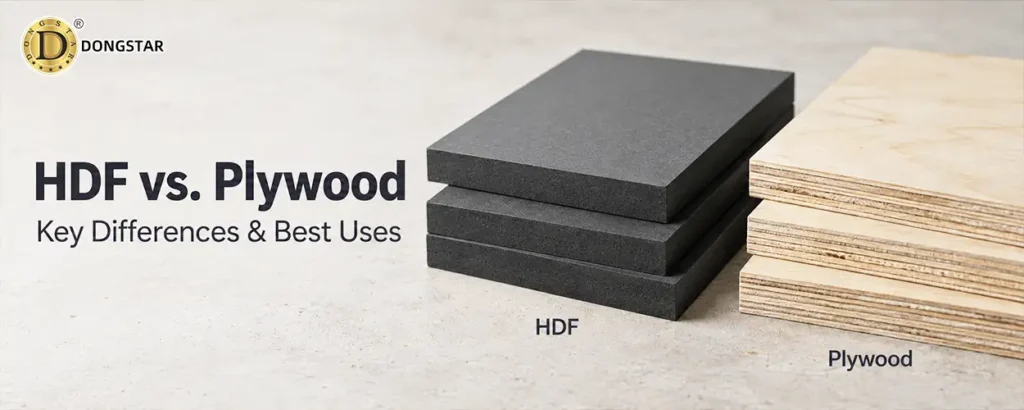
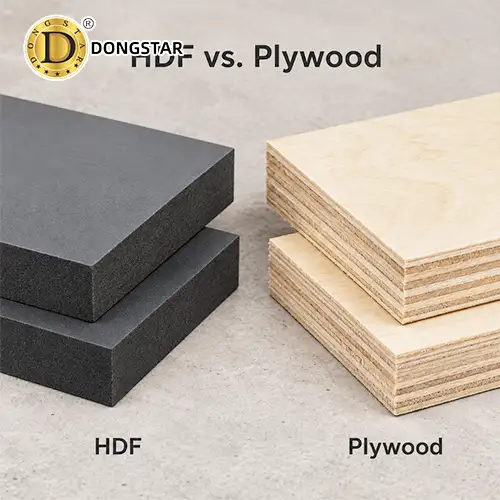
HDF is a dense wood-fiber panel suited to smooth surfaces, interior door skins and specified flooring cores. Veneer-core plywood uses cross-laminated wood veneers and is generally the stronger choice for cabinet boxes, loaded shelving and applications requiring reliable fastener retention. Moisture performance depends on the actual grade, adhesive and finished assembly—not the material name.

For project contractors, wholesalers and importers, the useful question is: which specification delivers the required performance at the lowest cost per usable component?

HDF vs. Plywood-Which Board Should Bulk Buyers Choose

HDF vs. Plywood at a Glance

This comparison refers to dry-process HDF and veneer-core plywood. Decorative plywood can also have an MDF or other composite core, so confirm the construction on the quotation.

Buying factorHDFVeneer-core plywood
ConstructionFine wood fibers bonded and compressed into a dense panelWood veneers bonded in alternating grain directions
SurfaceSmooth and uniform for coating or laminationDepends on face veneer and sanding quality
StrengthGrade-dependent; density alone does not establish load capacityOften better suited to loaded components; grade, thickness and span matter
FastenersPerformance varies with thickness, density and edge distanceUsually a better starting point for hinges and structural joints
MoistureStandard grades can swell when wet; moisture-resistant grades need verificationPerformance depends on bond classification, core and protection
WeightOften heavier at equal thicknessVaries significantly by core species
Typical usesDoor skins, flooring cores, supported back panelsCabinet boxes, shelving, furniture frames; structural work with rated grades
CostCan offer economical surface finishingMay reduce reinforcement, fixing and handling costs

Neither material is automatically waterproof, structural or compliant with a destination market’s requirements.

HDF vs. Plywood

What Is HDF?

High-density fiberboard is manufactured from refined wood fibers, resin and additives pressed under heat and pressure. Its uniform structure provides a consistent surface without visible veneer joints or natural grain patterns.

HDF is commonly used in laminate flooring cores, interior door skins and thin furniture components. Products sold as HDF vary in density, thickness and moisture performance. Request the technical data sheet rather than treating “high density” as a complete specification.

HDF and MDF belong to the same broad family of fiber-based panels, but they are not interchangeable grades. If a supplier lists both on one product page, confirm which thicknesses and properties apply to the HDF being quoted.

What Is Plywood?

Veneer-core plywood consists of thin wood sheets bonded in alternating grain directions. This construction helps distribute loads and limits the movement associated with a single piece of solid wood.

For buyers, the important variables are core species, veneer quality, layup, face grade, bond performance and thickness tolerance. Two panels described as “18 mm plywood” can perform very differently during machining and assembly.

Use the plywood core guide to compare constructions before selecting a face veneer or requesting prices.

HDF vs. Plywood for Cabinets and Commercial Furniture

For cabinet boxes, wall-mounted units and loaded shelves, cabinet grade plywood is often the more practical starting point. It can provide a useful combination of stiffness, manageable weight and fastener retention, provided the core is sound and the assembly is properly designed.

HDF can be suitable for supported cabinet backs, drawer bottoms and selected decorative components. Thin panels should not be substituted for loaded parts without checking deflection, fixing methods and the finished design.

For painted cabinet doors, compare the actual machining and coating performance of the proposed HDF or MDF grade. A smoother surface can reduce preparation work, but edge finishing and hardware attachment still need testing.

A mixed-material specification can make more sense than choosing one board for the entire cabinet: plywood for the box and loaded components, with an appropriate fiberboard grade for selected surface-focused parts.

For hospitality and retail fit-outs, inspect finished samples under the intended lighting. Surface defects that look minor on raw panels can become obvious after painting or high-gloss lamination.

HDF vs. Plywood for Flooring and Doors

Flooring: distinguish the core from the subfloor

HDF is widely used as the core of laminate flooring. The complete product combines the core with decorative and protective layers, a balancing layer and a joint system. Raw HDF board is not a finished commercial floor.

For flooring purchases, request the finished product’s use classification, wear performance, dimensional stability and water-resistance test results. A dense core alone does not establish suitability for heavy commercial traffic.

Plywood serves a different role in many floor assemblies: structural subflooring or specified underlayment. Select the grade and thickness for the support spacing, load and flooring manufacturer’s requirements. General decorative plywood should not be assumed suitable for structural subfloors.

Doors: surface quality and assembly quality both matter

HDF door skins suit interior-door production where consistent surfaces and repeatable finishes matter. Check skin thickness, molding quality, bonding and dimensional tolerances against an approved sample.

Plywood may be preferred where a natural veneer appearance or a particular door construction is required. Neither an HDF skin nor a plywood face establishes a fire or acoustic rating; those claims require evidence for the complete door assembly.

Moisture Resistance: Check the Grade, Not the Label

Standard HDF can suffer permanent thickness swelling when water reaches unprotected edges or joints. Moisture resistant HDF can perform better, but suitability depends on documented testing and the intended exposure.

Plywood also varies. Interior-bonded panels are not a substitute for exterior-bonded panels. For structural plywood, APA distinguishes Exposure 1 bonding for temporary weather exposure from Exterior bonding for longer-term exposure conditions. An exterior bond does not make wood immune to decay.

For sink cabinets, humid interiors or projects involving wet installation conditions, specify:

  • Expected exposure and the applicable panel grade.
  • Bond durability or thickness-swelling requirements, with the test method.
  • Edge sealing, joint protection and storage conditions.
  • Acceptance criteria for swelling, delamination and flatness.

Ask for the adhesive and bond-test specification. Labels such as “MR” or “WBP” on a quotation should be supported by measurable requirements. Dongstar’s plywood glue options provide a starting point for that discussion.

HDF vs. Plywood Cost: Compare Landed Cost and Yield

HDF may offer a lower purchase price for some applications, especially where a smooth surface reduces finishing work. That advantage can narrow if heavier panels increase freight costs or the component requires additional support.

Plywood may cost more per sheet but reduce weight, reinforcement or assembly work. Core defects and face quality can still affect cutting yield and reject rates.

A useful comparison is:

Cost per usable component = (landed panel cost + processing cost + expected rework and waste cost) ÷ accepted components produced.

For illustration, assume two sheets each produce four components. A $24 sheet costs $6 per component before processing. A $20 sheet also costs $6 per component if it requires $4 of additional processing per sheet. These are hypothetical figures, not current market prices.

Compare quotes using the same dimensions, tolerance, finish, packing and Incoterm. For bulk plywood orders or HDF shipments, confirm both container volume and payload limits rather than assuming equal sheet counts mean equal freight efficiency.

What to Confirm Before a Bulk Order

An HDF board supplier or plywood supplier in China should quote against a written specification covering:

  1. Application: cabinet box, door skin, flooring core or another defined component.
  2. Panel construction: fiberboard grade or plywood core, layup and face quality.
  3. Dimensions: thickness, tolerance, sheet size, flatness and cutting requirements.
  4. Performance: relevant bending, fastener, bonding or swelling tests.
  5. Market documentation: product-specific emissions, sourcing and other required records.
  6. Shipment: quantity, pallet protection, loading plan, delivery terms and inspection criteria.

For covered composite wood products entering the United States, verify applicable TSCA Title VI certification, labeling and records. Do not assume a generic “E0,” “E1” or “CARB” statement establishes every required obligation. Confirm the product category and current destination requirements before ordering.

Approve a production-representative sample and retain it as the reference for inspection. A sample is most useful when it has been cut, finished and assembled using your intended process.

FAQ

Higher density does not automatically mean greater strength. Veneer-core plywood is generally better suited to loaded cabinet parts and fastened assemblies, while HDF offers a uniform surface. Compare relevant test values at the specified thickness and span.

Standard HDF is not waterproof. Moisture-resistant grades and finished flooring systems can offer improved performance, but their test conditions and limits must match the application. Protect cut edges and joints.

Plywood is often preferred for cabinet boxes and loaded shelving. Suitable HDF or MDF grades may be used for selected doors and supported components. Around sinks, panel specification and edge protection are particularly important.

It can be, but prices depend on grade, thickness, finish, order size and delivery terms. Compare landed cost, processing and usable yield rather than the supplier's sheet price alone.

Do not substitute ordinary HDF for specified structural plywood. Structural applications require panels qualified for the design, loads and applicable building requirements.

Include the application, destination, dimensions, panel grade, finish, quantity and required documentation. State the Incoterm and inspection criteria so suppliers can prepare comparable quotations.

Compare Specifications Before Requesting a Quote

Dongstar lists MDF and HDF board options, hardwood plywood and HDF door skins for furniture and interior applications. Confirm grade-specific availability and documentation for your order.

Planning a project or wholesale plywood purchase? Send Dongstar your panel specification with the application, destination, size, thickness, finish and quantity. Request a comparison of suitable grades, samples, packing and delivery terms before committing to bulk supply.

Table of Contents

MDF has become one of the most practical materials for decorative furniture and interior projects because it combines a smooth surface, consistent structure and flexible finishing options.

For project buyers, furniture manufacturers, wholesalers and importers, however, choosing MDF for decorative applications is not simply about selecting a color or pattern. The substrate, thickness, density, surface finish, machining quality and emission requirements can all affect the final result.

So, what makes MDF suitable for decorative applications, and which specifications should buyers confirm before placing a bulk order?

What Is MDF for Decorative Applications?

MDF for decorative applications is medium-density fibreboard used as a substrate for furniture, wall features, doors, cabinetry, retail displays, architectural millwork and other interior products.

Its fine and relatively uniform fiber structure provides a smooth surface that can be painted, laminated, veneered, routed or finished with decorative materials. This makes MDF particularly useful when the appearance of the finished panel is as important as the basic board performance.

Dongstar’s current MDF/HDF range includes raw MDF, moisture-resistant MDF, fire-retardant MDF and HDF, with plain, melamine paper, HPL, PVC and other surface options. The company lists MDF thicknesses from 2–30 mm and standard 1220 × 2440 mm sheets, with custom specifications available.

MDF boards for decorative applications in furniture and interior projects

Why Is MDF Popular for Decorative Projects?

The main advantage is not just appearance. It is the combination of surface quality and manufacturing flexibility.

For furniture and interior manufacturers, MDF can support:

  • Smooth painting and coating

  • Melamine lamination

  • PVC surface application

  • Natural or engineered wood veneer

  • CNC cutting and routing

  • Edge profiling

  • Decorative grooves and patterns

  • Customized furniture components

Unlike panels with a coarse or irregular surface, MDF provides a more consistent substrate for decorative finishing. This is one reason MDF continues to be widely used for furniture, cabinetry, wall panels and decorative interior components.

7 Common MDF Decorative Applications

1. Decorative Furniture Panels

MDF is widely used for cabinet doors, wardrobe components, shelving, tables, office furniture and storage systems.

For manufacturers producing large quantities, the uniform structure of MDF makes it suitable for repeated cutting, drilling, routing and finishing.

18mm MDF board is particularly common for furniture components where a relatively substantial panel is required, while thinner boards may be selected for backs, decorative inserts and lighter components.

2. Kitchen Cabinets and Wardrobes

MDF works well for cabinet doors and visible furniture surfaces because it can accept a wide range of decorative finishes.

Depending on the project, buyers may specify:

  • Raw MDF for painting or further processing

  • Melamine-faced MDF for ready-to-use surfaces

  • PVC-faced MDF for specific decorative effects

  • Veneered MDF for a natural wood appearance

For large furniture programs, buyers should confirm whether the decorative surface is required on one or both sides.

3. Decorative Wall Panels

MDF is increasingly used as a substrate for decorative wall panels, feature walls, retail displays and interior architectural elements.

Depending on the design, MDF can be processed into:

  • Slatted panels

  • Grooved panels

  • Routed designs

  • Embossed surfaces

  • Decorative wall sections

  • Custom architectural patterns

The important point for importers is that the MDF substrate and the finished decorative system are not always the same specification. Surface material, machining, installation method and project requirements should be confirmed separately.

4. Interior Doors and Decorative Door Components

MDF can be used for interior doors, door skins, panels and decorative door components where a smooth and machinable substrate is required.

For door manufacturing, buyers should pay particular attention to thickness consistency, density, surface quality and machining performance.

If the project has specific fire, acoustic or moisture requirements, those requirements should be included in the original RFQ rather than added after production.

5. Retail Displays and Commercial Interiors

Retail stores, showrooms, hotels, offices and commercial interiors often require large quantities of visually consistent panels.

MDF can be used for:

  • Display fixtures

  • Shelving systems

  • Counter panels

  • Decorative partitions

  • Feature walls

  • Branded furniture

  • Reception and office furniture

For these projects, color consistency and repeatability between production batches can be just as important as the board’s basic specifications.

6. CNC Decorative MDF Components

MDF is well suited to CNC routing and precision machining because of its relatively uniform internal structure.

Manufacturers can use CNC processing to create letters, grooves, profiles, geometric patterns, cabinet components and customized decorative shapes.

For CNC production, buyers should not evaluate MDF only by nominal thickness. Thickness tolerance, density consistency, surface quality and edge performance can directly influence machining efficiency and material waste.

7. Decorative Flooring and Interior Components

MDF and HDF can also be used in selected flooring and interior component applications.

Dongstar lists MDF/HDF applications including furniture, interior decoration and wood flooring, while HDF provides a denser panel option for applications requiring different physical characteristics.

Which Decorative MDF Finish Should You Choose?

The best finish depends on how the finished product will be used.

MDF FinishTypical B2B Applications
Raw MDFPainting, CNC routing, veneering, custom finishing
Melamine MDFCabinets, wardrobes, shelving, office furniture
PVC-faced MDFDecorative furniture and interior panels
HPL-faced MDFCommercial furniture and higher-wear applications
Wood veneer MDFPremium furniture and architectural interiors
Textured / embossed MDFDecorative walls, furniture and feature panels

Dongstar currently lists plain, melamine paper, HPL, PVC and leather-type surface options, together with matte, textured, glossy, embossed and other surface treatments. Its product page also states that more than 1,000 color options are available across solid, wood-grain, cloth-grain and marble-grain designs.

For large projects, buyers should approve a physical sample or agreed decorative reference before mass production because screen colors and actual production finishes can differ.

What MDF Thickness Is Best for Decorative Applications?

There is no single thickness that fits every decorative application.

Dongstar lists MDF from 2–30 mm, including 2.7, 3, 6, 9, 12, 15 and 18 mm, with custom specifications available.

Typical purchasing considerations include:

  • 2–6 mm: lightweight decorative parts, backs and inserts

  • 9–12 mm: decorative panels and lighter furniture components

  • 15 mm: furniture and interior components

  • 18 mm: cabinets, shelving, furniture panels and heavier decorative components

  • 25–30 mm: thicker furniture or specially designed project components

These are starting points rather than structural recommendations. The final thickness should be based on the design, span, fixing method, machining process and applicable project requirements.
What Should Importers Check Before Buying Decorative MDF?

A decorative MDF quotation should include more than price per sheet.

Before placing a bulk order, confirm:

  1. MDF type: Raw, MHR, FR MDF or HDF

  2. Panel size: such as 1220 × 2440 mm

  3. Thickness: including acceptable tolerance

  4. Density: required range

  5. Surface: raw, melamine, HPL, PVC, veneer or other finish

  6. Color or decor code: approved sample/reference

  7. Emission requirement: E0, E1, E2 or destination-market requirement

  8. Machining: CNC, grooves, profiles or other processing

  9. Certification: documents required for the destination market

  10. Packaging: export pallet or other agreed packing

  11. Quantity: project quantity or container requirement

  12. Destination: port and country

Dongstar’s current MDF specifications include density from 650–1200 kg/m³, E0/E1/E2 glue options, ±0.2–0.5 mm thickness tolerance and standard export pallet packing. Exact specifications should be confirmed against the quotation and production order.

Why Source Decorative MDF from Dongstar?

For international buyers, decorative MDF sourcing is ultimately a supply-chain decision.

Dongstar is a China-based wood panel manufacturer and supplier offering MDF/HDF together with plywood, OSB, particle board, melamine board and other engineered wood products. Its MDF product range supports different thicknesses, sizes, surface treatments and board types for furniture and interior applications.

For project and wholesale orders, buyers can provide the required size, thickness, density, surface finish, quantity, destination and documentation requirements so the specification can be confirmed before quotation.

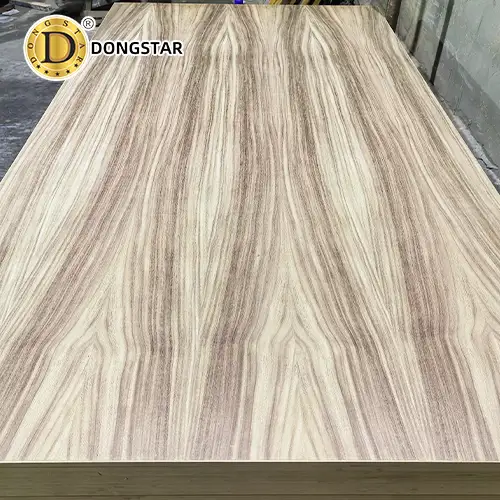
Decorative MDF panels with wood grain finishes and CNC routed designs

MDF Decorative Applications: Buyer FAQ

Yes. MDF is widely used for decorative furniture, cabinetry, wall panels, doors, retail fixtures and interior components because of its smooth surface and machining flexibility.

Decorative MDF board generally refers to MDF used with a decorative finish or decorative processing, such as melamine, HPL, PVC, veneer, painting, grooves or CNC patterns.

18mm MDF can be suitable for many furniture and interior applications, but the appropriate thickness depends on the panel design, fixing method, span and required performance.

Yes. MDF can be supplied in different thicknesses, dimensions, densities and surface finishes. Decorative processing and packaging can also be discussed according to the project.

Neither is universally better. Raw MDF provides greater flexibility for painting, veneering and further processing, while melamine MDF provides a ready decorative surface and can reduce additional finishing work.

Final Thoughts

MDF remains a practical choice when a project requires a combination of smooth appearance, machining flexibility and decorative versatility.

For global buyers, the most important decision is not simply choosing “decorative MDF.” It is defining the complete specification: substrate, thickness, density, dimensions, surface, decor, emissions, machining, packaging and documentation.

For bulk orders, send the required MDF specification, decorative finish, quantity and destination to the manufacturer before requesting a quotation. A clear RFQ makes it much easier to compare suppliers and avoid costly specification changes later.

Table of Contents

When a commercial project requires both the appearance and machinability of MDF and a higher level of fire performance, standard MDF may not be enough. This is where fire-resistant MDF board, also called fire-retardant MDF or FR MDF, becomes relevant.

For furniture manufacturers, interior contractors, wholesalers, importers and project buyers, the important question is not simply whether an MDF board is called “fire resistant.” The real issue is whether the exact board specification has the fire-performance documentation required for the destination market and project.

Dongstar supplies FR MDF (Red) as part of its MDF/HDF product range, alongside standard MDF, moisture-resistant MDF and HDF. Its published MDF/HDF specifications cover different sizes, thicknesses, densities, surfaces and packaging options.

What Is Fire-Resistant MDF Board?

Fire-resistant MDF board is an engineered wood panel designed with improved fire-retardant performance compared with standard MDF.

It is generally produced by incorporating fire-retardant properties into the MDF manufacturing process rather than simply relying on a conventional surface coating.

The purpose is to reduce or delay the spread of flame and improve the panel’s reaction to fire under specified test conditions.

However, there is an important distinction:

Fire-retardant MDF is not automatically the same as a fire-resistance-rated wall, door or building assembly.

A board’s fire classification depends on its composition, thickness, surface treatment, test method and, in some applications, the complete installed system. International fire-rated MDF products are tested under different standards, including EN 13501-1 and ASTM E84, so buyers should always match the test report to the project specification.

China Fire-Resistant MDF Board

Fire-Resistant MDF vs Standard MDF

The basic manufacturing principle is similar, but FR MDF is developed with additional fire-performance requirements.

FeatureStandard MDFFire-Resistant MDF
Main materialWood fiberWood fiber with fire-retardant formulation
SurfaceSmooth and machinableSmooth and machinable, depending on product
Main purposeFurniture and interior applicationsApplications requiring specified fire performance
Typical color identificationNatural/light brownOften color-coded, depending on manufacturer
Fire testingMay not be required for a standard productTest documentation is normally important
Typical procurementFurniture and general interiorsCommercial/public interiors and specified projects

The exact performance should always be established from the manufacturer’s technical data and test documents rather than from the board’s color or product name.

Dongstar’s current product page identifies FR MDF with a red core and lists it alongside Raw MDF, MHR MDF and HDF.

Where Is Fire-Resistant MDF Used?

FR MDF is particularly relevant when MDF is required for an interior application but the project specification also includes fire-performance requirements.

Common applications include:

1. Commercial Furniture

Fire-retardant MDF can be considered for furniture and fixtures in commercial environments where fire performance is part of the project specification.

Typical products include:

  • Office furniture

  • Reception counters

  • Cabinets

  • Display units

  • Shelving

  • Retail fixtures

  • Decorative furniture components

The required fire classification should be confirmed before production.

2. Hotels and Hospitality Projects

Hotels contain many interior wood-based products, including decorative wall elements, furniture, cabinets, doors and public-area fixtures.

Where the project documents specify a fire classification, FR MDF can be considered as a suitable substrate when its tested performance matches the requirement.

3. Public Buildings

Schools, hospitals, offices, museums, transportation facilities and other public buildings may have more demanding fire-safety requirements.

In these projects, buyers should request the complete technical documentation before material approval rather than selecting a product solely because it is marketed as “fire resistant.”

4. Interior Wall and Decorative Panels

FR MDF can be used as a substrate for certain decorative interior systems, including wall panels and architectural millwork.

The final fire performance may depend on the MDF core, veneer, melamine, paint, fabric, adhesive and installation method. Some tested products therefore specify the complete system configuration rather than the bare board alone.

5. Partitions, Ceilings and Architectural Millwork

Where non-structural interior panels are required to meet a specified reaction-to-fire classification, fire-retardant MDF may be considered.

It should not, however, be treated as a structural fire-rated assembly unless the complete assembly has been tested and approved for that use.

What Fire Standards Should MDF Buyers Know?

This is one of the most important parts of buying fire-resistant MDF board internationally.

Different countries and projects may use different test methods and classification systems.

EN 13501-1

EN 13501-1 is widely used in Europe for the classification of construction products and building elements according to their reaction to fire.

Some FR MDF products on the international market are tested and classified under this system. For example, manufacturers publish classifications such as B-s1,d0 for specific FR MDF products.

ASTM E84

ASTM E84 is commonly referenced in North American projects for evaluating surface burning characteristics.

Some fire-retardant MDF products are tested to ASTM E84 and may receive Class A or other classifications depending on the exact product and test result.

Other Standards

Depending on the destination market, buyers may encounter:

  • CAN/ULC-S102

  • BS 476

  • EN 622-5

  • EN 13501-1

  • ASTM E84

  • Local building-code requirements

The correct standard should come from the project’s specification, architect, consultant or local authority.

Do not compare two FR MDF products simply because both say “fire rated.” Compare the actual test standard, classification, thickness, surface and test report.

Is Fire-Resistant MDF the Same as Fireproof MDF?

No.

“Fireproof MDF” is often used as a marketing expression, but professional buyers should avoid treating it as a technical classification.

A more precise approach is to ask:

  1. What fire test was performed?

  2. What was the exact classification?

  3. What board thickness was tested?

  4. Was the board tested raw or with a surface finish?

  5. Was the complete wall, ceiling or furniture system tested?

  6. Who issued the test report?

  7. Does the result apply to the product being quoted?

This approach is especially important for large commercial projects where material approval is required before procurement.

Fire-Resistant MDF Board Supplier

What Thickness Is Available for Fire-Resistant MDF?

FR MDF can be produced in different thicknesses depending on the manufacturer and application.

For general MDF/HDF supply, Dongstar currently lists thicknesses from approximately 2mm to 30mm, including 6mm, 9mm, 12mm, 15mm and 18mm, with 1220 × 2440mm listed as a standard sheet size. The exact thickness availability for FR MDF should be confirmed for the specific order.

For furniture and interior projects, the most appropriate thickness depends on the product design, machining requirements, fixing method and required performance.

Do not select a thicker board simply because it appears more fire resistant. Fire performance must be established from the applicable test data.

Can Fire-Resistant MDF Be Customized?

Depending on production capability and order quantity, buyers may discuss:

  • Sheet dimensions

  • Thickness

  • Density

  • Surface finish

  • Emission requirements

  • Color or core identification

  • Packaging

  • Quantity

  • Project-specific documentation

Dongstar’s published MDF/HDF range includes 1220 × 2440mm and 2100 × 2500mm for thinner boards, with other dimensions available upon request. It also lists plain, melamine, HPL, PVC and other surface options.

For a fire-sensitive project, however, customization should be confirmed before production because changing the thickness, surface or finishing system may affect the applicability of existing test documentation.

What Should Global Buyers Check Before Ordering FR MDF?

For a container or project order, a professional RFQ should contain much more than “fire-resistant MDF.”

Product Specification

State:

  • FR MDF board

  • Sheet size

  • Thickness

  • Density

  • Surface finish

  • Quantity

Fire Requirement

Specify:

  • Required fire standard

  • Required classification

  • Test method

  • Required certificate or report

  • Destination market

Emission Requirement

Also confirm the required formaldehyde or emission standard.

Dongstar’s general MDF/HDF product information lists E0/E1/E2 glue options, while certifications listed on the product page include ISO, CE, CARB and FSC. These should not automatically be interpreted as fire certifications; the applicable documentation for the exact FR MDF specification should be confirmed separately.

Packaging and Logistics

For bulk orders, confirm:

  • Export packaging

  • Pallet configuration

  • Number of sheets per pallet

  • Container loading

  • Shipping marks

  • Destination port

  • Required export documents

Dongstar lists loose packing and standard export pallet packing for its MDF/HDF range.

Why Choose Dongstar for FR MDF Supply?

Dongstar is a China-based wood-panel supplier serving international buyers with MDF/HDF and other engineered wood products.

Its current MDF/HDF product range includes:

  • Raw MDF

  • Moisture-resistant MDF

  • Fire-retardant MDF

  • HDF

  • Melamine-faced MDF

  • HPL-faced MDF

  • PVC-faced MDF

The published range covers multiple sizes, thicknesses, densities and surface treatments, allowing buyers to discuss different specifications according to their applications.

For importers and project buyers, another practical advantage is Dongstar’s broader wood-panel portfolio, which includes plywood, OSB, particle board and melamine board. This can simplify procurement when a project requires several types of engineered wood panels.

For an FR MDF order, however, the key point is documentation. Buyers should ask Dongstar to confirm the exact fire-performance specification and provide the relevant test documentation for the product being quoted.

FR MDF Buying Checklist for Importers

Before approving a supplier, check these items:

ItemBuyer Should Confirm
ProductFR MDF / fire-retardant MDF
SizeStandard or custom
ThicknessExact nominal thickness
DensityRequired range
SurfaceRaw / melamine / HPL / PVC / other
Fire standardEN 13501-1 / ASTM E84 / project requirement
Fire classificationExact tested result
Test reportAvailable for quoted product
EmissionRequired market standard
CertificationDestination-market requirements
PackagingExport specification
QuantitySheets / m³ / containers
DestinationCountry and port

This checklist helps importers compare suppliers on the same technical basis instead of comparing only price per sheet.

FAQs About Fire-Resistant MDF

Fire-resistant MDF is an MDF panel developed with improved fire-retardant performance for applications where a specified reaction-to-fire requirement applies.

FR MDF is formulated to provide improved fire performance compared with standard MDF. The actual performance depends on the product formulation and applicable test result.

No. Fire resistance and moisture resistance are different properties. If a project requires both, buyers should specify the appropriate MDF grade for each performance requirement.

Yes, FR MDF can be used for furniture and interior components where the product's fire performance is appropriate for the project. The required classification should be confirmed before purchase.

Not necessarily. Some manufacturers use red cores to identify FR MDF, including Dongstar's published FR MDF (Red), but color alone is not proof of a fire classification. Buyers should request the technical specification and applicable test report.

Ask for the exact board specification, fire-test standard, classification, test report, thickness, density, surface configuration, emission requirements, MOQ, packaging and delivery terms.

Final Thoughts

Fire-resistant MDF board is not simply “MDF that does not burn.” It is a specialized engineered wood panel whose fire performance must be evaluated against a defined test method and project requirement.

For global importers, wholesalers, furniture manufacturers and project contractors, the safest purchasing approach is to specify the required fire standard first and then select the MDF product that has documentation supporting that requirement.

Dongstar offers FR MDF (Red) within its MDF/HDF range and can discuss size, thickness, density, surface and bulk-order requirements with international buyers. The exact fire classification and supporting documentation should be confirmed for the specific FR MDF product before project approval.

If you are sourcing fire-resistant MDF board, fire-retardant MDF or FR MDF in bulk, send the required fire standard, board specification, quantity and destination to Dongstar for a project-specific quotation.

Table of Contents

If you are sourcing wood panels for furniture, interior projects, distribution or large-scale manufacturing, you have probably come across MDF board.

But what exactly is MDF board, how is it made, what is it used for, and how do you choose the right specification when buying in bulk?

MDF stands for Medium Density Fiberboard. It is an engineered wood panel made from refined wood fibers bonded with resin and pressed under controlled heat and pressure. Unlike solid wood, MDF has a relatively uniform structure and a smooth surface, which makes it suitable for machining, painting, laminating and furniture manufacturing.

For importers, wholesalers, project contractors and furniture manufacturers, however, the definition is only the starting point. The more important questions are usually about MDF thickness, density, size, surface, emission requirements, certifications and supply consistency.

What is MDF Board

What Is MDF Board?

MDF board is an engineered wood panel manufactured by processing wood material into fine fibers, mixing the fibers with a bonding system and forming them into panels under heat and pressure.

The manufacturing process creates a relatively homogeneous board without the natural grain variations and knots found in solid timber.

This gives MDF several characteristics that are valuable in industrial production:

  • Smooth and uniform surface

  • Consistent internal structure

  • Good CNC machining performance

  • Easy painting and finishing

  • Suitable for laminating and veneering

  • Consistent panel dimensions

  • Available in a wide range of thicknesses and densities

For furniture factories, this consistency can make MDF easier to process repeatedly than many natural wood materials.

How Is MDF Board Made?

The basic MDF manufacturing process involves several stages.

1. Wood Fiber Preparation

Wood material is processed into fine fibers. The quality and preparation of these fibers influence the final board structure.

2. Fiber Blending

The fibers are combined with resin and other required additives. The bonding system can vary according to the MDF grade and target market.

3. Mat Formation

The prepared fibers are distributed into a uniform mat according to the required board density and thickness.

4. Hot Pressing

The fiber mat is pressed under controlled temperature and pressure to form a solid panel.

5. Sanding and Finishing

After pressing, the boards can be trimmed and sanded to achieve the required thickness and surface quality.

Depending on the product, the MDF can then receive additional treatments such as melamine paper, HPL, PVC or other decorative surfaces.

This manufacturing structure is one reason MDF is widely used for furniture and interior products where a smooth, machinable substrate is required.

What Is MDF Board Used For?

MDF is primarily used in furniture manufacturing, interior decoration and other applications where a smooth, consistent and easily machinable panel is required.

Common applications include:

Furniture Manufacturing

MDF is widely used for:

  • Cabinets

  • Wardrobes

  • Desks

  • Tables

  • Shelving

  • TV cabinets

  • Storage furniture

  • Decorative furniture components

Kitchen Cabinets

MDF can be used for cabinet doors, panels and decorative components. Its smooth surface is particularly suitable for painted or laminated finishes.

Where higher moisture resistance is required, buyers should specify an appropriate moisture-resistant MDF grade rather than assuming that standard MDF is suitable for wet environments.

Office and Commercial Furniture

Commercial furniture manufacturers use MDF for office desks, storage cabinets, reception counters, display systems and other interior furniture.

Interior Decoration

MDF can also be processed into:

  • Decorative wall panels

  • Mouldings

  • Feature walls

  • Interior partitions

  • Decorative strips

  • Ceiling elements

  • Acoustic panel substrates

Doors and Decorative Components

MDF can be used for interior door components, door skins and routed decorative designs. Its uniform structure works well with CNC cutting and profiling.

The appropriate MDF grade depends on the application, environment and performance requirements.

What Are the Main Types of MDF Board?

There is no single MDF specification suitable for every project. Manufacturers and buyers can select different grades according to the intended application.

Raw MDF

Raw MDF is an unfinished panel that can be painted, veneered, laminated or processed by the buyer.

It is commonly used as a substrate for further furniture manufacturing.

Moisture-Resistant MDF

Moisture-resistant MDF is designed for applications where the board may encounter higher humidity than standard interior conditions.

It should not automatically be treated as waterproof. Buyers should check the manufacturer’s technical data and select the grade according to the actual environment.

Fire-Retardant MDF

Fire-retardant MDF is produced for applications where specific fire-performance requirements apply.

The required certification or fire classification should be confirmed according to the destination market and project specification.

HDF

HDF, or High Density Fiberboard, is a denser form of fiberboard and is used for applications requiring different density and performance characteristics.

Dongstar’s current MDF/HDF range includes Raw MDF, MHR MDF, FR MDF and HDF, depending on the selected specification.

What MDF Thickness Should You Buy?

MDF thickness should be selected according to the furniture design, machining process, required rigidity and final application.

Commonly purchased specifications include:

MDF ThicknessTypical Applications
2–3 mmBack panels, thin components and decorative parts
6 mmCabinet backs and interior components
9 mmFurniture parts and decorative panels
12 mmFurniture components and shelving
15 mmFurniture, doors and interior applications
18 mmCabinets, shelving and furniture panels
22–25 mmHeavy furniture and specialized components
30 mmThick furniture components and customized projects

These are purchasing guidelines rather than structural design recommendations.

For example, 18mm MDF board is a commonly requested specification for furniture because it provides a useful balance between panel thickness, rigidity, machining and material consumption.

Dongstar currently lists MDF/HDF from approximately 2mm to 30mm, including 2.7mm, 3mm, 6mm, 9mm, 12mm, 15mm and 18mm.

What Is the Standard MDF Board Size?

One of the most widely used MDF formats is 1220 × 2440mm, commonly described as a 4×8 MDF board.

International buyers may encounter several versions of the same size:

  • 1220 × 2440mm MDF

  • 2440 × 1220mm MDF

  • 4×8 MDF board

  • 4×8 MDF sheet

  • 48 × 96 inch MDF

For large-volume orders, buyers should always confirm the actual finished dimensions and tolerance with the manufacturer.

Dongstar lists 1220 × 2440mm as a standard MDF/HDF size and also indicates that other sizes can be discussed according to requirements.

What Is MDF Density and Why Does It Matter?

Density is an important specification when comparing MDF suppliers.

Two boards can have the same size and thickness but different densities. This can affect:

  • Sheet weight

  • Machining behaviour

  • Screw holding performance

  • Surface quality

  • Panel rigidity

  • Container loading

  • Material cost

Dongstar currently lists MDF/HDF density from approximately 650 to 1200 kg/m³, depending on the product specification.

For a professional RFQ, it is therefore better to specify the required density or application rather than asking only for “18mm MDF.”

MDF Board for Furniture

What Surface Options Are Available?

MDF can be supplied as a raw panel or with different decorative surfaces.

Depending on the product, common options include:

  • Plain or sanded MDF

  • Melamine-faced MDF

  • HPL-faced MDF

  • PVC-faced MDF

  • Decorative finishes

  • Matte surfaces

  • Glossy surfaces

  • Textured or embossed surfaces

Dongstar’s published MDF/HDF specifications include plain boards as well as melamine paper, HPL and PVC surface options.

For furniture manufacturers, the surface should be selected according to the production process. A factory that already has painting or laminating equipment may prefer raw MDF, while a distributor may require ready-to-use decorative panels.

MDF Board vs Particle Board: What Is the Difference?

MDF and particle board are both engineered wood panels, but their structures are different.

MDF is made from finer wood fibers and has a relatively uniform structure. It is particularly suitable for smooth painted surfaces, CNC machining, routing and decorative furniture.

Particle board, also called chipboard, is manufactured from larger wood particles. It is widely used in cost-sensitive furniture and panel applications.

For a buyer, the choice should be based on the application rather than simply asking which material is “better.”

MDF is often considered when surface quality and detailed machining are important, while particle board can be attractive for applications where material cost and lightweight construction are key factors.

For a more detailed purchasing comparison, see Dongstar’s guide to MDF vs Particle Board.

What Should Global Buyers Check Before Buying MDF Board?

For project orders and container-scale purchasing, price per sheet should not be the only consideration.

A complete MDF purchasing specification should include:

SpecificationWhat to Confirm
Size1220 × 2440mm or custom size
ThicknessRequired thickness
DensityRequired density range
GradeRaw / MR / FR / HDF
SurfacePlain / Melamine / HPL / PVC
Glue / EmissionRequired market standard
Thickness toleranceManufacturer’s declared tolerance
CertificationDestination-market requirements
PackagingExport packaging
QuantitySheets / pallets / containers
DestinationCountry and port

Dongstar’s published MDF/HDF specifications include E0/E1/E2 glue options and certifications including ISO, CE, CARB and FSC. The exact certification and technical specification should be confirmed for the product being quoted.

Why Choose Dongstar for China MDF Board Supply?

For international buyers, sourcing from a manufacturer is about more than finding a low initial quotation.

Dongstar is a China-based wood-panel manufacturer and supplier offering MDF/HDF together with plywood, OSB, particle board, melamine board and other engineered wood products.

Its current MDF/HDF range covers standard 1220 × 2440mm sheets, approximately 2–30mm thicknesses, different board types and multiple surface options.

This gives furniture manufacturers, importers, wholesalers and project contractors the opportunity to discuss different specifications within a broader wood-panel supply chain.

For a bulk order, buyers can provide the required size, thickness, density, surface, emission standard, quantity, packaging and destination port. A complete specification allows the manufacturer to prepare a more meaningful quotation and reduces misunderstandings before production.

What Should You Put in an MDF Wholesale RFQ?

Instead of sending:

“Please quote MDF board.”

A professional RFQ should look more like this:

Product: MDF Board
Size: 1220 × 2440mm
Thickness: 18mm
Density: Required range
Surface: Raw / Sanded / Melamine
Emission: Required standard
Quantity: Project / Container quantity
Packaging: Export packaging
Destination: Port and country
Certification: Required documents

This approach makes it easier to compare different MDF board suppliers, MDF sheet manufacturers and wholesale quotations on the same technical basis.

FAQs About MDF Board

MDF stands for Medium Density Fiberboard. It is an engineered wood panel made from wood fibers bonded with resin and formed under controlled heat and pressure.

MDF is widely used for furniture, cabinets, wardrobes, shelving, office furniture, decorative panels, doors and interior applications.

18mm MDF is commonly used for furniture, cabinets, shelves and other relatively thick panel components. The appropriate thickness depends on the product design, span, fixing method and expected load.

1220 × 2440mm is a widely used MDF sheet format, commonly known as a 4×8 MDF board.

Standard MDF should not be treated as waterproof. For applications involving higher humidity, buyers should specify a suitable moisture-resistant grade and follow the manufacturer's technical recommendations.

Depending on production capability and order quantity, manufacturers may offer customized dimensions, thicknesses, densities, surfaces and other specifications. Buyers should confirm MOQ, tolerance and lead time before ordering.

Final Takeaway: What Is MDF Board?

MDF board is an engineered wood panel designed for consistent manufacturing, machining and finishing. Its smooth surface and uniform structure make it especially useful for furniture, cabinets, interior decoration and other commercial applications.

For international buyers, however, “MDF board” is not a complete purchasing specification.

Before ordering, confirm the size, thickness, density, MDF grade, surface treatment, emission requirements, certification, packaging and quantity.

For many furniture applications, 18mm MDF and 1220 × 2440mm MDF are important commercial specifications, while other thicknesses and sizes can be selected according to the project.

If you are looking for a China MDF board supplier, MDF sheet manufacturer or bulk MDF supplier, Dongstar can discuss the required specification and provide a project-specific quotation.

Table of Contents

MDF has become one of the most practical engineered wood panels for modern furniture manufacturing. Its smooth surface, uniform structure and good machining performance make it suitable for high-volume production of cabinets, wardrobes, office furniture, shelving and decorative components.

For international project buyers, furniture manufacturers, wholesalers and importers, however, choosing a China MDF board supplier is not simply about finding the lowest price. Board thickness, dimensions, density, surface finish, emission requirements, packaging and production consistency all influence the final manufacturing cost.

Among commonly purchased specifications, 18mm MDF board and 1220x2440mm MDF board are widely used for furniture production because they provide a practical combination of panel size, rigidity and machining flexibility.

This guide explains the main China Furniture MDF Board applications and what international buyers should consider when sourcing MDF from China.

China Furniture MDF Board

Why Is MDF Widely Used in Furniture Manufacturing?

Medium Density Fiberboard is manufactured from refined wood fibers bonded with resin and pressed under controlled heat and pressure. Unlike natural wood, MDF has a relatively uniform internal structure with fewer natural defects.

This makes MDF particularly suitable for industrial furniture production where consistent machining and surface quality are important.

For furniture manufacturers, the main advantages include:

  • Smooth and uniform surface

  • Consistent panel structure

  • Easy CNC cutting and routing

  • Suitable for painting and veneering

  • Good compatibility with melamine and decorative surfaces

  • Available in different thicknesses and densities

  • Suitable for mass production

  • Easy to process into customized furniture components

For these reasons, MDF is commonly used in both residential furniture manufacturing and commercial applications such as offices, hotels, retail stores and interior fit-out projects.

1. MDF for Kitchen Cabinets

Kitchen cabinets are one of the most important applications for MDF.

MDF can be machined into cabinet doors, side panels, shelves and decorative components. Its smooth surface is particularly useful when manufacturers need painted, laminated or decorative finishes.

For large furniture factories, 18mm MDF board is often considered for cabinet components where a relatively thick and rigid panel is required.

Moisture-resistant MDF may also be considered for applications exposed to higher humidity, depending on the project specification.

When purchasing MDF for kitchen furniture, buyers should confirm:

  • Board thickness

  • Density

  • Moisture resistance requirements

  • Surface finish

  • Formaldehyde/emission requirements

  • Machining requirements

  • Edge treatment

  • Packaging

The correct MDF grade should always be selected according to the furniture design and local technical requirements.

2. MDF for Wardrobes and Bedroom Furniture

Wardrobes, closets and bedroom furniture require panels that can be accurately cut, drilled and finished.

A 1220x2440mm MDF board is a practical format for many furniture production lines because the 1220 × 2440 mm sheet is commonly used as a 4×8 panel.

Typical applications include:

  • Wardrobe doors

  • Sliding doors

  • Side panels

  • Shelves

  • Dressing tables

  • Bedside cabinets

  • Storage units

For large-scale production, consistent dimensions are particularly important. Variations in thickness or sheet size can affect CNC programs, cutting layouts, edge banding and overall material utilization.

This is why furniture manufacturers should evaluate a China MDF board supplier based on production consistency rather than price alone.

3. MDF for Office Furniture

Commercial furniture manufacturers also use MDF for office desks, cabinets, reception counters, storage systems and meeting-room furniture.

The material can be finished with melamine paper, HPL, PVC, veneer or paint depending on the final design.

For office furniture projects, buyers may compare:

Raw MDF: suitable when the factory performs its own painting, veneering or laminating.

Melamine-faced MDF: useful when a ready-to-use decorative surface is required.

HDF: suitable for applications requiring a denser engineered wood panel.

Dongstar’s current MDF/HDF range includes raw MDF, moisture-resistant MDF, fire-retardant MDF and HDF, together with several surface treatment options.

4. MDF for Shelving and Storage Furniture

Shelves and storage furniture require a balance between panel thickness, rigidity, weight and production cost.

For many commercial furniture applications, 15mm and 18mm MDF board are practical starting points, although the final thickness should be determined by the shelf span, fixing method, expected load and furniture design.

The 18mm specification is particularly relevant for:

  • Bookcases

  • Storage cabinets

  • Office shelving

  • Retail fixtures

  • Display units

  • Heavy furniture components

For importers, it is important to compare MDF using the same density and technical specification. An 18mm board from two different suppliers may not have the same weight or performance if their density differs.

5. MDF for Decorative Furniture Components

MDF is not limited to flat furniture panels.

Its uniform structure makes it suitable for CNC routing, profiling and other machining processes. Furniture manufacturers can use MDF to produce decorative doors, moulded components, wall features, retail displays and architectural millwork.

This is one reason why MDF remains popular among manufacturers producing customized furniture.

For these applications, buyers should pay particular attention to:

  • Surface smoothness

  • Internal density consistency

  • Edge quality

  • Thickness tolerance

  • CNC machining performance

  • Sanding quality

  • Finishing requirements

A stable manufacturing specification can reduce production adjustments and material waste.

1220x2440mm MDF Board

Why Is 18mm MDF Board Popular for Furniture?

The popularity of 18mm MDF board comes from its practical balance between thickness, rigidity, weight and machinability.

For many furniture components, 18mm provides more panel thickness than 12mm or 15mm MDF without moving into much thicker and heavier board specifications.

Common applications include:

ApplicationCommon MDF Starting Range
Cabinet components12–18mm
Wardrobe panels15–18mm
Furniture panels15–18mm
Shelving15–18mm
Decorative panels6–18mm
Back panels2.7–6mm
Heavy furniture components18mm or thicker

These ranges are purchasing guidelines rather than structural design specifications. The final thickness should be selected according to the actual furniture design and technical requirements.

Dongstar currently lists MDF/HDF thicknesses from approximately 2mm to 30mm, including 12mm, 15mm and 18mm options.

Why Do Furniture Buyers Choose 1220x2440mm MDF Board?

1220x2440mm MDF board is commonly recognized as a 4×8 MDF sheet and is familiar to furniture manufacturers in many international markets.

The format can be convenient for:

  • CNC cutting

  • Panel nesting

  • Cabinet production

  • Furniture component cutting

  • Export packaging

  • Standard container loading

However, buyers should not assume that every “4×8 MDF” board has exactly the same finished dimensions.

For a large production order, the RFQ should clearly specify:

  • Finished length and width

  • Thickness

  • Thickness tolerance

  • Density

  • Surface finish

  • Grade

  • Emission standard

  • Quantity

  • Packaging

Dongstar lists 1220 × 2440mm as a standard MDF/HDF size and also indicates that other specifications can be discussed according to requirements.

What Should You Check When Buying China Furniture MDF Board?

A reliable China Furniture MDF Board supplier should be able to provide clear technical information before production.

For a wholesale or container order, international buyers should confirm at least:

Board Specification

Specify the exact size, thickness, density and MDF grade instead of simply requesting “MDF board.”

Surface

Confirm whether the board is raw, sanded, melamine-faced, HPL-faced, PVC-faced or otherwise finished.

Emission Requirements

The required glue and emission specification should match the destination market and furniture application.

Certification

Ask for applicable documentation such as FSC, CE, CARB or ISO certification where required.

Packaging

Export packaging should protect panels from moisture, impact and handling damage during international transportation.

Production Consistency

For repeated furniture production, stable thickness, density and surface quality are more valuable than a low first-order quotation.

Dongstar’s published MDF/HDF specifications include E0/E1/E2 glue options, density from approximately 650–1200 kg/m³ depending on product, and certifications including ISO, CE, CARB and FSC. The exact specification should be confirmed for the product being quoted.

Why Source China MDF Board from Dongstar?

Dongstar is a China-based wood-panel manufacturer and supplier serving international buyers with MDF/HDF and other engineered wood products.

Its MDF/HDF range includes standard 1220 × 2440mm panels, thicknesses from approximately 2–30mm, different MDF/HDF grades and multiple surface options.

For furniture manufacturers, wholesalers, importers and project buyers, this product range can help cover different procurement requirements within one wood-panel supply chain.

Dongstar also supplies other major panel products, including plywood, OSB, particle board and melamine board. This can be useful for buyers who need several panel materials for furniture manufacturing or commercial interior projects.

The key point is not simply that Dongstar supplies MDF from China. For a professional buyer, the more important questions are whether the supplier can maintain the required specification, communicate clearly about technical requirements and support stable bulk supply.

What Information Should Be Included in an MDF Wholesale RFQ?

A detailed RFQ allows a manufacturer to provide a more accurate quotation.

Instead of sending:

“Please quote 18mm MDF.”

A better inquiry would include:

Product: MDF Board
Size: 1220 × 2440mm
Thickness: 18mm
Density: Required range
Surface: Raw / Sanded / Melamine / HPL
Emission: Required standard
Quantity: Sheets / pallets / containers
Packaging: Export packaging
Destination: Country and port
Certification: Required documents

This format also makes it easier to compare several MDF board wholesale suppliers on the same technical basis.

China MDF Board FAQ

Yes. 18mm MDF is commonly considered for cabinets, wardrobes, shelving, furniture panels, office furniture and other applications where a relatively thick, machinable panel is required.

Yes. 1220 × 2440mm is a widely used 4×8 sheet format and can be suitable for CNC cutting, cabinet production and furniture component manufacturing.

There is no single thickness for every application. 12mm, 15mm and 18mm are commonly considered for different furniture components, with the final choice depending on design, span, load and manufacturing requirements.

Depending on production capability and order quantity, buyers may discuss customized dimensions, thickness, density, surface treatment and other technical specifications with the manufacturer.

Yes. Depending on the selected product, surface options can include melamine paper, HPL, PVC and other finishes.

Importers should compare the complete specification, including density, thickness tolerance, surface, emission requirements, certification, packaging, MOQ, container loading and total landed cost—not only the price per sheet.

Final Thoughts

For global furniture manufacturers, project contractors, wholesalers and importers, China MDF board can be a practical solution for high-volume furniture production when the product specification and supplier capability are properly matched.

18mm MDF board and 1220x2440mm MDF board are particularly relevant specifications for many furniture and interior applications, but successful bulk purchasing requires more than selecting a size and thickness.

Before placing an order, confirm the MDF grade, density, thickness tolerance, surface, emission requirements, certification, packaging and quantity.

If you are sourcing China Furniture MDF Board for furniture production, wholesale distribution or a commercial project, Dongstar can provide MDF/HDF specifications and discuss the requirements for your specific order.

Table of Contents

Finding a reliable MDF board wholesale supplier is not simply about getting the lowest price per sheet.

For importers, furniture manufacturers, distributors and project contractors, the real challenge is finding an MDF sheet manufacturer that can keep specifications consistent across large orders, support the required sizes and finishes, provide suitable documentation, and deliver reliably.

This is where Dongstar positions itself differently.

As a China-based wood panel manufacturer and supplier, Dongstar supplies MDF and HDF together with plywood, OSB, particle board, melamine board and other engineered wood products. Its business is built around wholesale, project and international supply rather than small retail orders.

For buyers comparing an MDF board bulk supplier, custom size MDF board manufacturer or factory-direct supplier, here are the key points worth considering.

Dongstar MDF Board Factory

Why Is Supplier Selection Important for MDF Bulk Orders?

MDF looks simple from the outside. A buyer specifies the size and thickness, receives a quotation and places an order.

In practice, a large MDF purchase involves much more.

Density, thickness tolerance, surface quality, moisture content, emission class, packaging and loading efficiency can all affect the final result. Two boards with the same nominal dimensions can perform differently if their technical specifications are not controlled consistently.

For a container buyer, an inconsistent batch can create much bigger problems than a slightly higher initial purchase price.

That is why experienced importers usually compare suppliers based on the complete specification rather than price alone.

Dongstar: A Wood Panel Supplier Built for B2B Buyers

Dongstar Group was established in Linyi, China, one of the country’s major wood-panel manufacturing centers. Dongstar’s current product portfolio includes MDF Board, HDF, plywood, film faced plywood, OSB, particle board, melamine board and fancy plywood.

The company describes its business as serving global markets with factory-based wood panel production, technical support and customized solutions.

For buyers who purchase several types of panels, this product range is useful because MDF does not always exist as an isolated procurement requirement. A furniture manufacturer, distributor or construction-material importer may need MDF together with plywood, OSB or particle board.

Working with one experienced wood panel supplier can simplify quotation, specification management, packaging and shipment coordination.

What Does Dongstar Offer as an MDF Sheet Manufacturer?

Dongstar’s MDF/HDF range covers different thicknesses, sizes, densities, surface treatments and board types.

The currently listed MDF specifications include 1220 × 2440 mm as a standard sheet size and thickness options extending from approximately 2 mm to 30 mm, including commonly requested specifications such as 3 mm, 6 mm, 9 mm, 12 mm, 15 mm and 18 mm.

Depending on the selected product, buyers can discuss options such as:

  • Raw MDF

  • HDF

  • Moisture-resistant MDF

  • Fire-retardant MDF

  • Melamine-faced MDF

  • HPL-faced MDF

  • PVC-faced MDF

  • Other customized surface solutions

For an importer, this matters because the right MDF is determined by the end application—not simply by the thickness.

Custom Size MDF Board Manufacturer for Project Requirements

Standard 1220 × 2440 mm MDF is widely used, but it is not the best format for every project.

Large furniture manufacturers, door factories, interior contractors and commercial projects may require different dimensions to improve material utilization or reduce cutting waste.

A custom size MDF board manufacturer can be particularly useful when the buyer needs:

  • Non-standard panel dimensions

  • Special thicknesses

  • Specific density

  • Customized surface treatment

  • Special emission requirements

  • Melamine or decorative finishes

  • OEM specifications

  • Project-specific packaging

Before requesting a customized MDF quotation, buyers should provide the target dimensions, thickness, quantity, surface requirements and intended application.

Customization should always be confirmed against the manufacturer’s production capability and minimum order quantity.

What Makes a Good MDF Board Wholesale Supplier?

For bulk buyers, a reliable supplier should be able to answer several practical questions before the order is confirmed.

1. Can the supplier maintain consistent thickness?

For furniture and CNC processing, thickness consistency is important.

A nominal 18 mm MDF panel, for example, should be supplied within the agreed production tolerance rather than varying significantly from batch to batch.

2. Is the density clearly specified?

Density affects panel weight, machining characteristics and application performance.

The buyer should request the density range for the exact MDF grade being quoted rather than relying on a general catalogue specification.

3. Can the supplier provide the required emission class?

Depending on the destination market, buyers may require specific formaldehyde emission or environmental standards.

The correct requirement should be agreed before production and supported by appropriate technical documents or test reports where applicable.

4. Can the supplier support different surfaces?

Furniture manufacturers may need raw MDF, while distributors and cabinet factories may prefer melamine-faced or other decorative surfaces.

A supplier with multiple surface options can reduce the need to source each panel type separately.

5. Can the factory handle container-scale orders?

A wholesale supplier should be able to discuss MOQ, production scheduling, pallet configuration, container loading and export packaging.

These details directly affect the landed cost of MDF.

MDF Board Bulk Supplier: What Should You Ask Before Ordering?

A professional MDF RFQ should contain more than:

“Please quote MDF board.”

For a bulk order, provide:

Product: MDF Board
Size: 1220 × 2440 mm or custom size
Thickness: 6 / 9 / 12 / 15 / 18 mm or required specification
Density: Required range
Surface: Raw / sanded / melamine / HPL / PVC
Emission: Required market standard
Quantity: Sheets / m³ / containers
Packaging: Export standard
Destination: Port and country
Certification: Required documents

This gives the manufacturer enough information to calculate a meaningful quotation.

It also makes supplier comparisons much easier.

China MDF Board Supplier Dongstar

Why Factory-Direct MDF Supply Can Be More Efficient

For large orders, purchasing directly from an MDF sheet manufacturer can provide advantages over buying through multiple trading layers.

The most important benefits are not necessarily limited to the factory price.

A direct manufacturer relationship can make it easier to discuss:

  • Product specifications

  • Customized dimensions

  • Trial orders

  • Sample approval

  • Production schedules

  • Quality inspection

  • Packaging

  • Container loading

  • Documentation

  • Repeat-order requirements

For buyers building a long-term supply chain, repeatability is often more valuable than saving a small amount on the first order.

What Applications Does Dongstar MDF Serve?

MDF is particularly common in furniture and interior manufacturing because of its smooth and relatively uniform structure.

Typical applications include:

Furniture

MDF can be used for cabinets, wardrobes, shelves, tables, office furniture and other interior furniture components.

Kitchen and Cabinet Production

Depending on the selected grade and surface, MDF can be used for cabinet components, doors, shelving and decorative panels.

Interior Decoration

MDF is commonly processed into wall features, partitions, decorative panels and other interior products.

Retail and Commercial Projects

Display fixtures, shelving, shop fittings and office interiors can also use MDF where the board specification is suitable.

The final grade should always be selected according to the actual application and local technical requirements.

Dongstar MDF vs. Other Wood Panel Options

Not every project should use MDF.

For structural applications, plywood may be a better choice.

For applications where a strand-based structural panel is preferred, OSB may be more suitable.

Particle board can be attractive where cost efficiency is a major consideration.

MDF is particularly valuable when a smooth surface, consistent structure and good machining performance are important.

For this reason, experienced buyers should first define the application and then select the panel.

Dongstar’s broader product portfolio allows buyers to compare MDF with plywood, OSB and particle board within the same supplier network.

What Should Global Importers Check Before Shipment?

Before a bulk MDF order leaves the factory, buyers should verify the agreed specifications.

A practical pre-shipment checklist includes:

  • Product type

  • Sheet dimensions

  • Thickness

  • Thickness tolerance

  • Density

  • Surface quality

  • Moisture content

  • Emission requirements

  • Quantity

  • Packaging condition

  • Pallet configuration

  • Shipping marks

  • Required certificates and documents

For large orders, a pre-shipment inspection can help identify specification problems before the cargo reaches the destination port.

Why Dongstar Can Be Considered for MDF Wholesale Supply

For a global importer, the value of a supplier is ultimately measured by consistency and service.

Dongstar combines a broad wood-panel product portfolio with factory-based sourcing, export-oriented supply and customized product support.

Its MDF/HDF range allows buyers to discuss different thicknesses, sizes, densities and surface options, while its wider plywood, OSB, particle board and melamine board portfolio can support buyers who prefer to consolidate wood-panel purchasing.

For distributors, furniture manufacturers and project contractors, this can simplify procurement and create a more consistent supply relationship.

MDF Board Wholesale Supplier FAQ

Yes. Dongstar supplies MDF/HDF as part of its international wood-panel product range and works with buyers sourcing wood panels for wholesale, projects and manufacturing.

Customized MDF specifications can be discussed according to size, thickness, surface, density, quantity and production requirements. Buyers should confirm feasibility and MOQ for each custom specification.

1220 × 2440 mm is one of the listed MDF/HDF sheet sizes. Other specifications should be confirmed according to the required product.

Dongstar lists MDF/HDF thicknesses from approximately 2 mm to 30 mm, including commonly requested 6 mm, 9 mm, 12 mm, 15 mm and 18 mm options.

Yes. Depending on the selected product, surface options can include melamine paper, HPL, PVC and other finishes.

Send the product type, dimensions, thickness, density, surface, emission requirement, quantity, destination port and packaging requirements. A complete RFQ allows Dongstar to prepare a more accurate quotation.

Final Thoughts: Choosing an MDF Supplier for Long-Term Supply

Choosing an MDF board wholesale supplier should be about more than finding the lowest factory price.

For importers and project buyers, a dependable supplier should provide consistent specifications, clear technical information, production flexibility, appropriate packaging and responsive communication.

Dongstar offers MDF and HDF together with a broader range of engineered wood panels, making it a practical option for buyers looking to consolidate wood-panel sourcing.

If you are looking for an MDF sheet manufacturer, custom size MDF board manufacturer or MDF board bulk supplier, send Dongstar your required specifications and order quantity for a project-specific quotation.

Table of Contents

If you are sourcing 18mm MDF board for furniture, cabinets, interior projects or wholesale distribution, the specification is more important than the price alone.

For international buyers, 18mm MDF 1220x2440mm is a practical combination because the 1220 × 2440 mm format is widely used as a 4×8 sheet, while 18 mm provides a good balance between panel rigidity, machinability and material efficiency.

But before placing a container order, buyers should look beyond “18mm MDF” and confirm the board size, density, thickness tolerance, emission class, surface finish, packaging and certification.

This guide explains what buyers should know when comparing an 18mm MDF board supplier, MDF manufacturer or wholesale supplier.

18mm MDF Board 1220x2440mm

What Is 18mm MDF Board?

18mm MDF board is a medium-density fibreboard panel manufactured from refined wood fibres combined with resin and pressed under controlled heat and pressure.

Compared with natural solid wood, MDF provides a relatively uniform structure and a smooth, consistent surface. This makes it suitable for machining, painting, laminating, veneering and other secondary processing.

For B2B buyers, 18mm MDF is particularly useful when a project requires a thicker panel without moving to significantly heavier or more expensive wood-based materials.

Dongstar lists MDF/HDF in 1220 × 2440 mm, with thicknesses from 2 mm to 30 mm, including 18 mm. The company also lists thickness tolerance of approximately ±0.2–0.5 mm, depending on the product specification.

18mm MDF 1220x2440mm: Is It a Standard Size?

Yes. 1220 × 2440 mm is commonly sold internationally as a 4×8 MDF sheet.

You may see the same specification written in different ways:

  • 18mm MDF 1220x2440mm

  • 1220×2440 MDF 18mm

  • 18mm MDF sheet 4×8

  • 4×8 MDF board

  • 2440x1220mm MDF

  • 18mm MDF panel

Although these terms describe essentially the same panel format, buyers should confirm the actual finished dimensions and dimensional tolerance with the manufacturer.

This is particularly important for large furniture orders. A small difference in panel dimensions can affect CNC cutting layouts, nesting efficiency, packaging and material consumption.

Why Is 18mm MDF Widely Used?

The popularity of 18mm MDF comes from a practical balance between thickness, weight, machining and rigidity.

For many furniture and interior applications, 18 mm is thick enough to provide a substantial panel while remaining relatively easy to cut, drill, route and edge-band.

Common applications include:

Furniture Manufacturing

18mm MDF is widely considered for:

  • Cabinets

  • Wardrobes

  • Shelving

  • Tables

  • Storage furniture

  • Office furniture

  • Display fixtures

Its consistent surface makes it suitable for painting, laminating and decorative finishing.

Kitchen Cabinets

For cabinet components and doors, 18mm MDF can provide a useful combination of panel thickness and machinability.

Depending on the final design, buyers may select raw MDF for further finishing or melamine-faced MDF when a decorative surface is required.

Interior Fit-Out

18mm MDF can also be used for:

  • Wall features

  • Decorative panels

  • Doors

  • Partitions

  • Architectural millwork

  • Retail displays

The correct thickness should always be selected according to the project design and installation requirements.

What Should You Check Before Buying 18mm MDF?

A professional buyer should never compare suppliers based only on the words “18mm MDF.”

At minimum, confirm the following specifications:

SpecificationWhat to Confirm
ProductRaw MDF / HDF / MR MDF / FR MDF
Size1220 × 2440 mm
Thickness18 mm
Thickness toleranceManufacturer’s declared tolerance
DensityRequired density range
SurfacePlain / sanded / melamine / HPL / PVC
Glue / emissionE0 / E1 / E2 / CARB or required standard
MoistureManufacturer specification
CertificationFSC / CE / CARB / ISO or destination-market requirement
PackagingLoose or export pallet packing
QuantitySheets, pallets or full-container order
DestinationPort and country

Dongstar’s current MDF/HDF specification lists plain or melamine/HPL/PVC/leather surfaces, raw MDF, MHR MDF, FR MDF and HDF options, with density ranging from approximately 650–1200 kg/m³ depending on the product.

The exact specification should therefore be confirmed for the specific MDF grade being quoted.

Samanea saman MDF

18mm MDF Board vs 15mm MDF: Which Should You Choose?

The choice depends on the application rather than thickness alone.

18mm MDF is generally more appropriate when a project requires a thicker, more rigid panel.

15mm MDF may be preferable when the buyer wants to reduce material weight or cost while retaining sufficient panel thickness for the application.

For example:

ApplicationPossible Starting Point
Cabinet components15–18mm
Shelving15–18mm
Furniture panels15–18mm
Decorative panels9–18mm
Lightweight components6–12mm
Heavy furniture components18mm or thicker

These are purchasing guidelines rather than structural design recommendations. The final specification should follow the furniture design, span, fixing method and applicable technical requirements.

Does 18mm MDF Cost More Than Thinner MDF?

Normally, yes, when comparing boards with otherwise similar specifications.

An 18mm MDF sheet contains more material per square meter than a 12mm or 15mm board. This generally affects the sheet price, weight and container loading calculation.

For importers, however, the lowest price per sheet does not always mean the lowest overall procurement cost.

A better comparison should include:

  1. Price per sheet
  2. Price per square meter
  3. Sheet weight
  4. Sheets per pallet
  5. Pallets per container
  6. Net and gross container weight
  7. Packaging cost
  8. Certification cost
  9. Surface treatment
  10. Delivery terms

For a large order, landed cost per square meter is often more useful than simply comparing the factory price of one sheet.

How Much Does an 18mm MDF Sheet Weigh?

The exact weight depends mainly on the board’s density.

For a 1220 × 2440 mm panel, the volume of an 18mm sheet is approximately 0.0535 m³.

The estimated weight can therefore be calculated as:

Sheet weight ≈ 0.0535 × MDF density

For example, if the MDF density is 700 kg/m³:

0.0535 × 700 ≈ 37.5 kg per sheet

If the density is 750 kg/m³:

0.0535 × 750 ≈ 40.1 kg per sheet

These are estimates. The actual shipping weight should be confirmed with the manufacturer based on the final density, moisture content and production specification.

This calculation is particularly useful for importers because MDF density affects both sheet weight and container loading.

Raw 18mm MDF or Melamine MDF?

This depends on how the board will be processed after arrival.

Raw 18mm MDF

Raw MDF is a good option when the buyer plans to:

  • Paint the surface
  • Apply wood veneer
  • Laminate the board
  • CNC machine the panel
  • Apply a customized finish

It can provide more flexibility for furniture manufacturers and processors.

Melamine-Faced 18mm MDF

Melamine MDF can be more convenient when the finished decorative surface is already required.

It can reduce additional finishing processes and is commonly considered for:

  • Wardrobes
  • Kitchen cabinets
  • Office furniture
  • Shelving
  • Retail fixtures

Dongstar lists MDF surface options including plain, melamine paper, HPL and PVC, allowing buyers to select a finish according to the project or downstream manufacturing process.

How to Choose an 18mm MDF Board Supplier?

When comparing an 18mm MDF board supplier, look at more than the quotation.

A reliable supplier should be able to clearly answer:

1. What is the exact board size?

Confirm whether the finished size is 1220 × 2440 mm and request the dimensional tolerance.

2. What is the MDF density?

Density affects weight, machining behaviour and panel performance.

3. What emission standard is available?

Ask whether the board can meet the requirements of your destination market.

4. What surface options are available?

Confirm whether the supplier can provide raw, melamine, HPL, PVC or other finishes.

5. What is the MOQ?

For wholesale purchasing, confirm whether the factory accepts mixed specifications or requires a full-container quantity for each specification.

6. How is the MDF packaged?

Export packaging is important when panels will travel long distances by sea.

7. Can the supplier provide samples and technical documents?

For a new supplier, requesting a sample and relevant technical documentation before mass production can reduce procurement risk.

What Makes a Good 18mm MDF Manufacturer?

For project buyers and importers, an 18mm MDF manufacturer should provide consistent production rather than simply a low first quotation.

Important factors include:

  • Stable thickness tolerance
  • Consistent density
  • Reliable surface quality
  • Controlled moisture content
  • Appropriate emission standards
  • Export experience
  • Stable production capacity
  • Proper packaging
  • Technical documentation
  • Clear communication before production

Dongstar presents itself as a China-based wood-panel manufacturer and supplier, with MDF/HDF, plywood, OSB, particle board and melamine board among its product categories.

For buyers sourcing several types of wood panels, this can also make supplier consolidation worth considering.

What Should You Include in an 18mm MDF Wholesale RFQ?

A clear RFQ saves time for both the buyer and manufacturer.

Instead of writing:
“Please send your best price for 18mm MDF.”
A better inquiry is:

Product: Raw MDF Board
Size: 1220 × 2440 mm
Thickness: 18 mm
Density: Required range
Surface: Plain / Sanded
Emission: Required standard
Quantity: Full container / project quantity
Packaging: Export pallet packing
Destination: Port and country
Certification: Required documents

This gives the factory enough information to prepare a meaningful quotation.

18mm MDF Board FAQ

Yes. Dongstar lists 18mm MDF in 1220 × 2440 mm, as part of its MDF/HDF range.

18mm MDF is commonly used for furniture, cabinets, shelving, interior decoration, doors, wall features and other applications where a relatively thick and machinable wood-based panel is required.

Not exactly. 3/4 inch equals 19.05 mm, while 18mm is a metric thickness. Buyers should specify the exact metric thickness required rather than assuming the two dimensions are identical.

Yes. Wholesale orders can be specified according to size, thickness, density, surface, emission standard, packaging and quantity. MOQ and customized specifications should be confirmed with the supplier before ordering.

Depending on the manufacturer's production capability and order quantity, buyers may be able to customize surface finish, density, emission requirements, dimensions and other specifications.

The right supplier should be evaluated on product consistency, technical specifications, certification, production capability, packaging, export experience and total landed cost—not only the lowest quoted price.

Final Buying Advice

For international buyers, 18mm MDF 1220x2440mm is a practical specification for many furniture and interior applications.

But the phrase “18mm MDF” alone does not provide enough information to compare suppliers.

Before placing a wholesale order, confirm the actual dimensions, thickness tolerance, density, surface, emission class, certification, packaging, MOQ and container loading plan.

If you are comparing an 18mm MDF board supplier, 18mm MDF manufacturer or 18mm MDF wholesale quotation, send the same technical specification to each supplier. This makes the comparison much more accurate and helps you identify the real cost and value of the material.

For current MDF specifications and bulk-order inquiries, contact Dongstar for a project-specific quotation.

Scroll to Top

Submit Now, Get Best Quote Today.​

Get in Touch

Please feel free to leave your information.

Dongstar- Plywood