Table of Contents
If you’ve ever walked through a lumber yard or reviewed a framing plan, you’ve likely seen stacks of Oriented Strand Board (OSB)—those large, rough-surfaced panels with a distinctive wood-strand pattern. But not all OSB is created equal. Depending on your project’s demands—whether it’s a dry interior wall or a load-bearing roof in a rainy climate—the right grade matters more than you might think.
In this guide, we’ll cut through the confusion and explain exactly what Oriented Strand Board is, how the four main types (OSB1, OSB2, OSB3, and OSB4) differ, and which one you should specify for your next build.
What Is Oriented Strand Board?
Oriented Strand Board is an engineered wood panel made by compressing layers of thin, rectangular wood strands with waterproof resins under high heat and pressure. The strands are “oriented”—meaning they’re aligned in specific directions—to maximize strength and structural performance.
Unlike solid wood, OSB offers consistent quality, fewer voids, and better dimensional stability. It’s also made from fast-growing softwoods and mill residuals, making it a more sustainable choice than many traditional materials.
But here’s the key: not every OSB panel can handle moisture, heavy loads, or outdoor exposure. That’s where the European grading system (EN 300) comes in—with four distinct classes: OSB1, OSB2, OSB3, and OSB4.
Understanding OSB Grades: Which One Fits Your Project?
OSB1 – For Dry, Non-Structural Use
Best for: Interior furniture, shelving, decorative panels
Moisture resistance: None (dry conditions only)
Load capacity: Low
Don’t use it for: Walls, floors, roofs, or anything structural
Think of OSB1 as the “light-duty” option. It’s affordable and smooth enough for painted cabinetry—but if there’s any chance of humidity or weight, skip it.
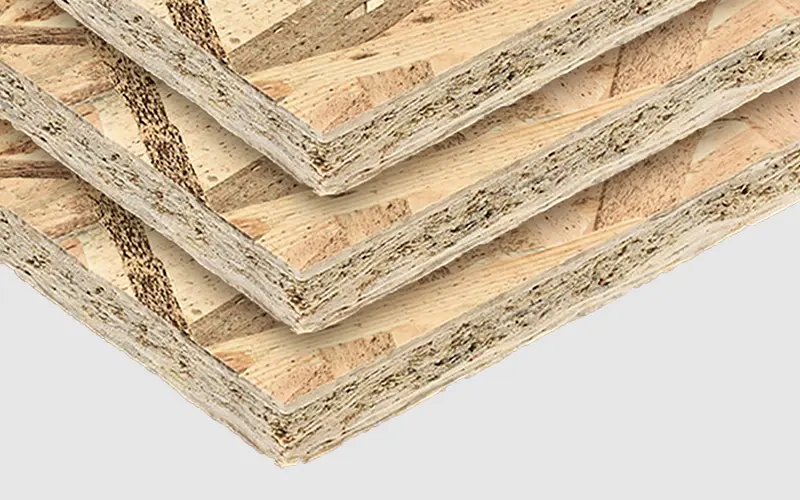
OSB2 – General Structural Use (Dry Conditions)
Best for: Interior walls, flooring, roof sheathing in climate-controlled buildings
Moisture resistance: Minimal (short-term exposure OK during construction)
Load capacity: Medium
Common in: Residential framing, partition walls, attic storage platforms
This is the most widely used grade in North America (often just labeled “OSB” without a number). It meets APA PRP-108 standards and works well when protected from long-term moisture.
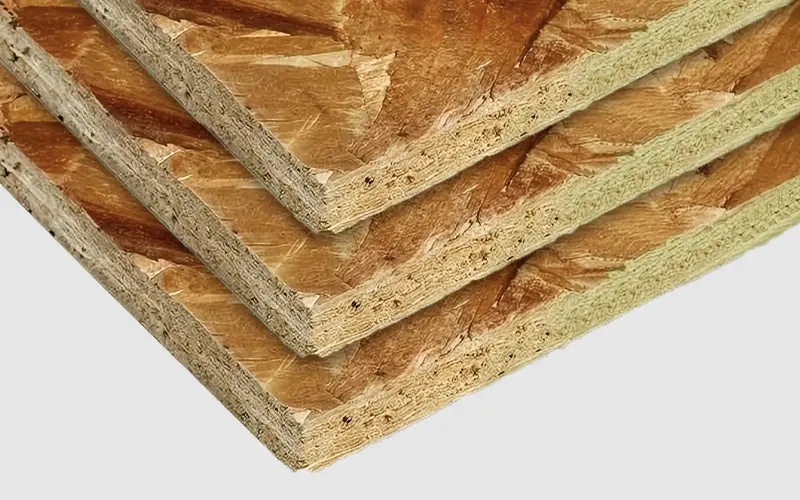
OSB3 – Structural Use in Humid Conditions
Best for: Exterior walls, roofs, subfloors, garages, sheds
Moisture resistance: High (designed for humid or temporarily wet environments)
Load capacity: High
Key feature: Contains more resin for better water resistance
If your project is exposed to rain during construction—or will be in a damp environment like a basement or coastal home—OSB3 is your go-to. It’s the standard for most modern residential builds in Europe and increasingly common in U.S. markets.
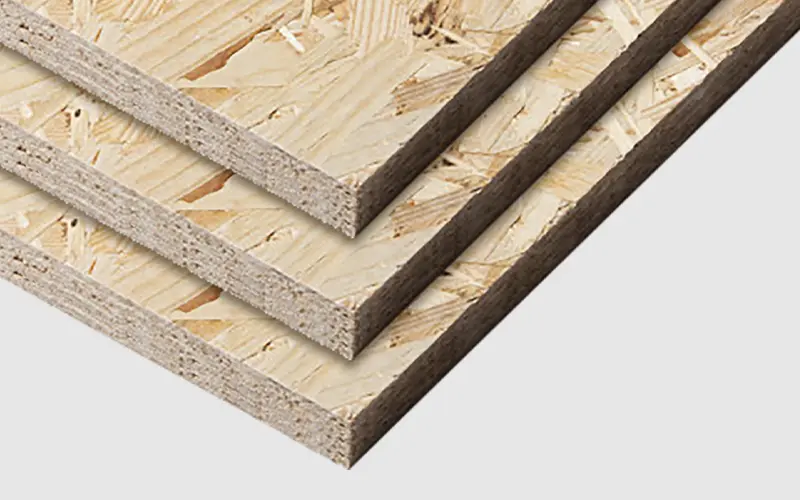
OSB4 – Heavy-Duty Structural Performance
Best for: Load-bearing floors, industrial applications, commercial roofing
Moisture resistance: Very high
Load capacity: Highest of all grades
Rarity: Less common; used in specialized projects
OSB4 is overkill for a backyard deck but essential for multi-story buildings or warehouse flooring where deflection and long-term durability are critical.
Always check the panel stamp. Look for “OSB/3” or “EN 300 OSB3” to confirm you’re getting the right grade. In North America, many products labeled simply “OSB” meet OSB2 or OSB3 performance—ask your supplier for test reports if in doubt.
Matching Grade to Job
| Project Type | Recommended OSB Grade |
| Kitchen cabinet backing | OSB1 |
| Interior wall sheathing | OSB2 |
| Roof decking (exposed) | OSB3 |
| Garage subfloor | OSB3 |
| Multi-family housing floor | OSB3 or OSB4 |
| Outdoor shed walls | OSB3 (with proper siding & flashing) |
Why Choose OSB Over Plywood?
- Cost: OSB is typically 15–25% cheaper than plywood.
- Consistency: No knots, splits, or core gaps.
- Eco-Friendly: Uses smaller trees and wood waste.
- Strength: Higher shear strength than plywood—great for seismic zones.
That said, plywood still wins for surface finish and edge stability in high-moisture scenarios. But for 90% of structural sheathing needs? OSB delivers more value per square foot.
Final Thoughts
Oriented Strand Board isn’t a one-size-fits-all product. Knowing the difference between OSB1, OSB2, OSB3, and OSB4 could save you from callbacks, warping, or even structural failure down the line. When in doubt, default to OSB3—it’s the safest bet for most residential and light commercial work.
And always—always—store panels flat, covered, and off the ground until installation day.