Table of Contents
If you’re planning a storage project, one of the first questions you’ll ask is: how much weight can particle board shelving actually hold?
The answer isn’t one-size-fits-all. But here’s the quick insight:
Most particle board shelves hold between 30–80 lbs (13–36 kg) depending on thickness, support, and design.
Now let’s break this down in a practical, project-focused way—so you can make the right decision for your application.
What Is Particle Board and Why It’s Used in Shelving
Composition and Manufacturing Process
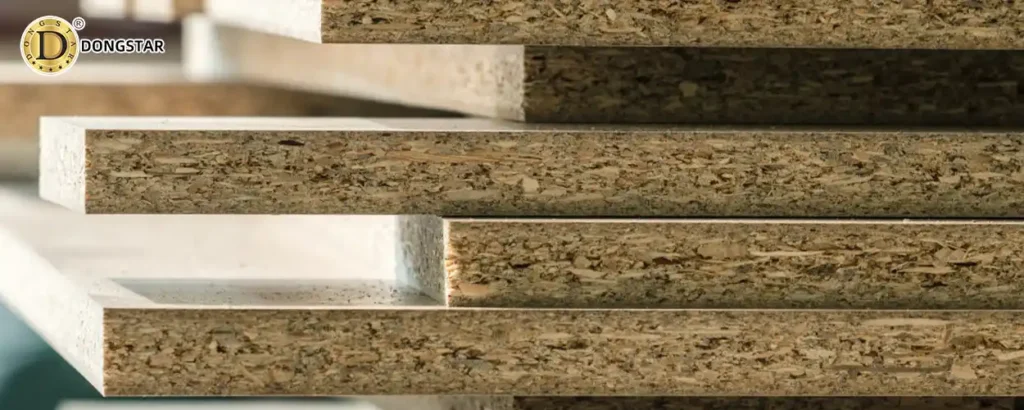
Particle board is an engineered wood product made from wood chips, sawdust, and resin pressed under heat and pressure.
This process creates a smooth, flat panel that’s easy to cut, laminate, and mass-produce.
Why Particle Board Is Popular in Projects
For project buyers, particle board shelving is attractive because it offers:
- Low cost compared to plywood or solid wood
- Consistent surface for laminates
- Lightweight structure for easy installation
- Scalable production for bulk orders
That’s why it’s widely used in:
- Retail shelving systems
- Flat-pack furniture
- Warehouse light-duty racks
However, its affordability comes with trade-offs—especially in load-bearing strength.
Average Weight Capacity of Particle Board Shelves
Standard Load Capacity by Thickness
Here’s a practical breakdown based on industry data:
| Thickness | Density Type | Typical Load Capacity |
|---|---|---|
| 12–13 mm (½”) | Standard | 20–30 lbs |
| 16 mm (⅝”) | Medium | 35–50 lbs |
| 18–19 mm (¾”) | High | 60–80 lbs |
In real-world use:
- A ¾-inch shelf (24” span) holds around 30–45 lbs safely
- Wider shelves (36”) may drop below 20 lbs capacity
Real-World Load Examples
| Application | Suitable? | Notes |
|---|---|---|
| Books | Moderate | Risk of sagging over time |
| Clothes | Yes | Ideal use |
| Kitchen storage | Limited | Needs reinforcement |
| Tools / heavy items | Not ideal | Use steel/plywood |
Key takeaway: particle board is best for light to medium loads, not heavy-duty storage.
Key Factors Affecting Particle Board Shelf Strength
Thickness and Density
This is the #1 factor.
- Doubling thickness can increase strength up to 4×
- Higher density boards resist bending better
Always choose ≥18mm for serious shelving projects
Span Length and Support Spacing
The longer the shelf, the weaker it becomes.
- 24” span = strong
- 36” span = significantly weaker
Add center supports for spans over 24 inches.
Load Distribution vs Point Load
- Evenly distributed weight = safer
- Concentrated load (e.g., heavy object in center) = failure risk
Place heavy items near brackets or supports.
Environmental Conditions (Moisture Impact)
Particle board is highly sensitive to moisture:
- Swelling reduces strength
- Warping leads to structural failure
Avoid in humid or outdoor environments unless sealed.
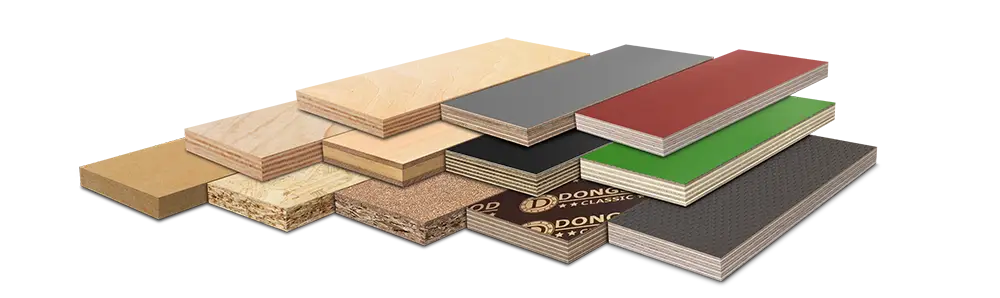
Particle Board vs Other Materials (MDF, Plywood, Steel)
Strength Comparison Table
| Material | Load Capacity | Durability | Cost |
|---|---|---|---|
| Particle Board | Low–Medium | Low |  |
| MDF | Medium | Medium | |
| Plywood | High | High | |
| Steel Shelving | Very High | Very High | |
For project buyers:
- Choose particle board shelving for cost efficiency
- Choose plywood/steel for heavy-duty applications
Common Failure Modes of Particle Board Shelving
Sagging and Deflection
The most common issue:
- Gradual bending under constant weight
- Permanent deformation over time
Screw Pull-Out and Structural Weakness
Particle board doesn’t hold screws well:
- Fasteners loosen over time
- Shelves collapse at connection points
How to Increase Particle Board Shelving Load Capacity
Adding Supports and Brackets
- Use metal brackets every 16–24 inches
- Add center supports for long shelves
Reducing Shelf Span
Shorter shelves = stronger shelves
This is the most effective improvement method
Reinforcement Techniques
- Add a solid wood strip underneath
- Use steel frame support systems
- Double-layer boards
Best Use Cases for Particle Board Shelving
Residential Applications
- Closets
- Decorative shelving
- Office storage
Commercial & Light Industrial Use
- Retail displays
- Light warehouse storage (with metal frames)
When supported by steel racks, capacity can reach 800–1200 lbs per shelf (because the frame carries the load)
When NOT to Use Particle Board Shelves
Avoid particle board shelving if:
- Heavy tools or machinery are stored
- High humidity environments exist
- Long-term durability is critical
Expert Tips for Project Buyers
- Always check load rating per shelf
- Prioritize support structure over board quality
- Don’t rely on particle board alone for structural loads
- Consider hybrid systems (particle board + steel frame)
FAQs About How to Waterproof Plywood
Typically 30–80 lbs, depending on thickness and support.
Yes, but only short spans and with reinforcement.
No, MDF generally has better density and strength.
Yes—thicker boards can be up to 4× stronger.
Add center supports and reduce span length.
Only when supported by a metal frame system.
Final Thoughts
For most projects, particle board shelving is a cost-effective solution for light to medium storage needs.
But here’s the truth project buyers care about:
Strength depends less on the board—and more on design, support, and installation
If you optimize those factors, particle board can perform far better than expected.